ARDMS SPI Practice Test: Complete 2026 Exam Guide + Free Questions
Last Updated: January 2026 | Reading Time: 18 minutes
Quick Summary: The ARDMS SPI (Sonography Principles & Instrumentation) exam is a 110-question, 2-hour test required for every ARDMS credential. With a 71% first-time pass rate, proper preparation is essential. This guide covers everything you need: exam format, content domains, 10 free practice questions, registration steps, and proven study strategies.
Table of Contents
What is the SPI Exam?
SPI Exam Format & Structure
Understanding the 5 Content Domains
Free SPI Practice Test Questions
SPI Exam Scoring & Pass Rate
How to Register for the SPI Exam
What to Expect on Exam Day
How Long Should You Study?
12 Tips to Pass the SPI Exam
FAQs
What is the SPI Exam?
You did it! You've graduated from sonography school and are one step closer to becoming a registered sonographer. Now, there's just one hurdle to overcome before you can officially earn your ARDMS credentials (RDMS, RDCS, RVT, or RMSKS)—passing the ARDMS SPI Exam.
The Sonography Principles & Instrumentation (SPI) exam is a standardized test administered by the American Registry for Diagnostic Medical Sonography (ARDMS). It evaluates your knowledge of ultrasound physics, instrumentation, and the scientific principles underlying diagnostic sonography.
Unlike specialty exams that focus on specific body systems (like abdominal or OB/GYN sonography), the SPI exam tests the physics concepts that apply to all sonography specialties. This is why it's required for every ARDMS credential.
Why the SPI is Challenging
The SPI is often considered one of the most challenging ARDMS exams because:
Abstract concepts: Unlike clinical exams where you can rely on anatomy knowledge, physics requires understanding mathematical relationships and wave behavior
Broad scope: Topics range from basic acoustics to advanced Doppler principles and bioeffects
High stakes: You cannot earn any ARDMS credential without passing the SPI
Many sonography students underestimate the SPI, focusing most of their energy on specialty exams. Don't make this mistake—the SPI requires dedicated study time.
SPI Exam Format & Structure
Understanding the exam format helps you prepare strategically:
Aspect
Details
Total Questions
110 multiple-choice
Scored Questions
~100 (10 are pilot questions)
Time Limit
2 hours (120 minutes)
Passing Score
555 (on a 300-700 scale)
Format
Computer-based testing
Testing Centers
Pearson VUE (in-person or online proctoring)
Exam Fee
$250 (as of 2026)

Question Types
All questions are multiple-choice with 4 answer options. You'll encounter:
Direct recall: Testing your memory of facts (e.g., "What is the speed of sound in soft tissue?")
Application: Applying concepts to scenarios (e.g., "If PRF increases, what happens to aliasing?")
Analysis: Interpreting data or images (e.g., "What artifact is shown in this image?")
Calculation: Solving physics equations (e.g., "Calculate the Doppler shift frequency")
Understanding Scaled Scoring
ARDMS uses a scaled scoring system to ensure fairness across different exam versions. Your score is based not only on correct answers but also on question difficulty. This means if you take a harder version of the exam, your score is adjusted accordingly—ensuring all test takers are judged fairly.
Time Management Strategy
With 110 questions in 120 minutes, you have approximately 65 seconds per question.
However, some questions take only 20-30 seconds while calculations may take 2-3 minutes. Use this pacing strategy:
First pass: Answer questions you know immediately (~60-70 questions)
Second pass: Work through moderate difficulty questions
Final pass: Tackle challenging calculations and review flagged items
Understanding the 5 Content Domains
The SPI exam is divided into five content domains, each weighted differently. Knowing these weights helps you prioritize your study time.
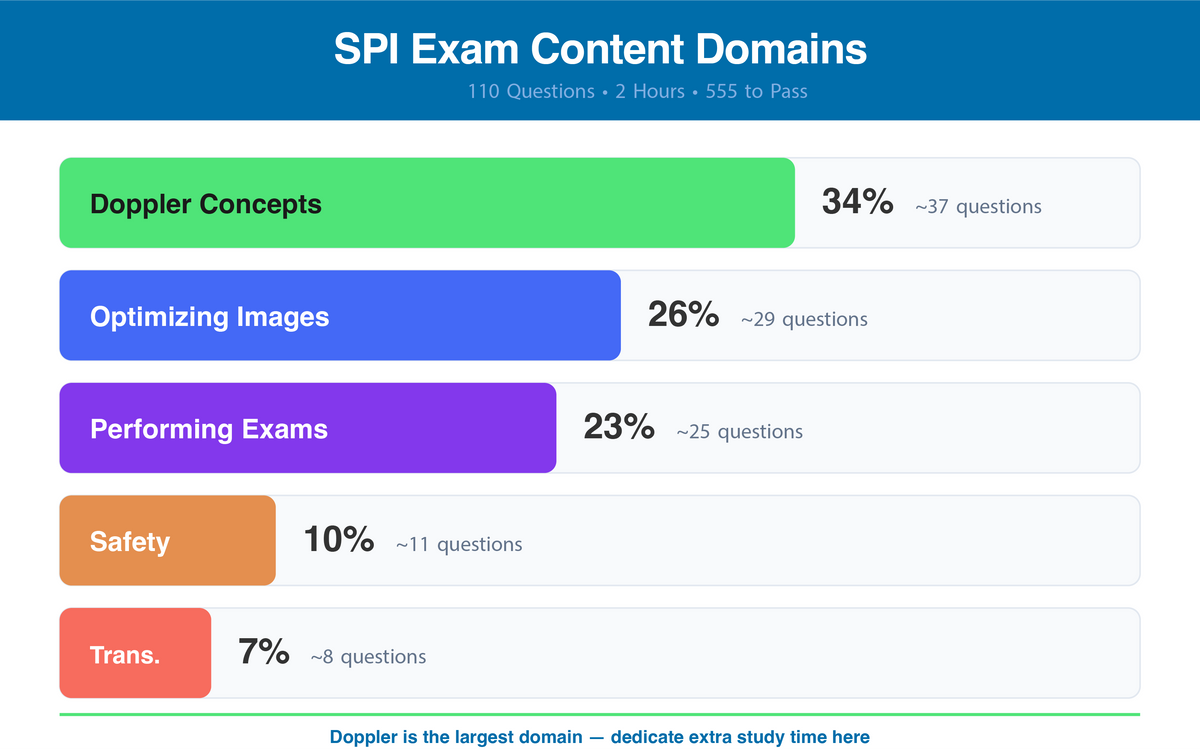
Domain 1: Performing Ultrasound Examinations (23%)
Approximately 25 questions
This domain covers the physics principles you apply during actual scanning:
Acoustic variables: Frequency, wavelength, amplitude, power, intensity
Propagation: Speed of sound in different media, acoustic impedance
Attenuation: Absorption, reflection, scattering, refraction
Transducer selection: Choosing appropriate frequency and type for clinical applications
Key formulas:
Speed = Frequency × Wavelength
c = 1540 m/s in soft tissue
Wavelength (mm) = 1.54 / Frequency (MHz)
Domain 2: Managing Ultrasound Transducers (7%)
Approximately 8 questions
This section delves into transducer technology and operation:
Piezoelectric effect: How crystals convert electrical energy to sound
Transducer construction: Matching layer, backing material, lens
Array types: Linear, curved, phased, annular
Beam characteristics: Near field, far field, focal zone
Resolution types: Axial, lateral, elevational (slice thickness)
Remember:
Axial resolution = SPL/2 (depends on frequency)
Lateral resolution = beam width (depends on focusing)
Domain 3: Optimizing Sonographic Images (26%)
Approximately 29 questions
The second-largest domain focuses on image quality:
Pulse-echo imaging: How images are formed
Display modes: A-mode, B-mode, M-mode
Instrument controls: Gain, TGC/DGC, dynamic range, persistence
Spatial resolution factors: Line density, frame rate
Temporal resolution: Frame rate optimization
Artifacts: Recognition and correction
Common artifacts to know:
Reverberation (comet tail, ring-down)
Shadowing and enhancement
Mirror image
Side lobe and grating lobe
Aliasing (Doppler)
Range ambiguity
Domain 4: Applying Doppler Concepts (34%)
Approximately 37 questions
This is the largest and most critical domain. Master these concepts:
Doppler equation: Understanding each variable
Spectral Doppler: Pulsed wave vs. continuous wave
Color flow imaging: Principles and limitations
Power Doppler: Advantages and applications
Hemodynamics: Laminar vs. turbulent flow, Bernoulli principle
Aliasing: Causes and solutions
Critical Doppler concepts:
1. Doppler shift = (2 × transmitted frequency × velocity × cos θ) / c
2. Nyquist limit = PRF/2
3. Aliasing occurs when Doppler shift > Nyquist limit
4. CW Doppler: No range resolution, no aliasing
5. PW Doppler: Has range resolution, subject to aliasing
Save this formula cheat sheet for quick reference during your studies.

Domain 5: Clinical Safety & Quality Assurance (10%)
Approximately 11 questions
Covers bioeffects and safety standards:
Thermal effects: Tissue heating mechanisms
Mechanical effects: Cavitation, microstreaming
Thermal Index (TI): TIS, TIB, TIC
Mechanical Index (MI): Cavitation risk indicator
ALARA principle: As Low As Reasonably Achievable
Output display standards: ODS requirements
Quality assurance: Phantom testing, calibration
Safety thresholds to remember:
TI < 1.0 for routine scanning
MI < 0.7 to minimize cavitation risk
Higher caution for obstetric and transcranial imaging
Free SPI Practice Test Questions
Test your knowledge with these sample SPI exam questions. Answers and explanations are provided below.
Question 1
What is the speed of sound in soft tissue?
A) 1480 m/s
B) 1540 m/s
C) 1600 m/s
D) 330 m/s
Question 2
Which resolution is determined by pulse duration?
A) Lateral resolution
B) Elevational resolution
C) Axial resolution
D) Temporal resolution
Question 3
A sonographer increases the PRF. What effect does this have on aliasing?
A) Increases aliasing
B) Decreases aliasing
C) No effect on aliasing
D) Eliminates aliasing
completely
Question 4
Which transducer type is best suited for cardiac imaging through the intercostal spaces?
A) Linear array
B) Curved array
C) Phased array
D) Annular array
Question 5
What does the Mechanical Index (MI) indicate?
A) Risk of thermal bioeffects
B) Risk of cavitation
C) Image resolution quality
D) Doppler sensitivity
Question 6
In pulsed wave Doppler, what determines the maximum detectable velocity without aliasing?
A) Transducer frequency
B) Pulse repetition frequency
C) Sample volume size
D) Wall filter setting
Question 7
Which artifact results from sound traveling through a fluid-filled structure?
A) Shadowing
B) Posterior acoustic enhancement
C) Reverberation
D) Mirror image
Question 8
The piezoelectric effect describes:
A) The conversion of heat to sound
B) The conversion of electrical energy to mechanical energy
C) The absorption of sound by tissue
D) The reflection of sound at interfaces
Question 9
What happens to axial resolution when frequency is increased?
A) Axial resolution improves (gets smaller)
B) Axial resolution worsens (gets larger)
C) Axial resolution remains unchanged
D) Axial resolution becomes equal to lateral resolution
Question 10
A Doppler angle of 90 degrees results in:
A) Maximum Doppler shift
B) Zero Doppler shift
C) Aliasing
D) Increased penetration
Answer Key with Explanations
Question 1: B) 1540 m/s
The assumed speed of sound in soft tissue is 1540 m/s (or 1.54 mm/μs). This value is used by ultrasound machines to calculate depth. Sound travels at 330 m/s in air and about 1480 m/s in water.
Question 2: C) Axial resolution
Axial resolution equals spatial pulse length divided by 2 (SPL/2). Since SPL depends on wavelength (and thus frequency) and number of cycles in the pulse, axial resolution is determined by pulse characteristics. Lateral resolution depends on beam width.
Question 3: B) Decreases aliasing
Increasing PRF raises the Nyquist limit (PRF/2), allowing higher Doppler shifts to be detected without aliasing. This is a primary method for reducing aliasing in pulsed wave Doppler.
Question 4: C) Phased array
Phased array transducers have a small footprint, making them ideal for imaging through narrow acoustic windows like intercostal spaces. They electronically steer the beam to create a sector-shaped image.
Question 5: B) Risk of cavitation
The Mechanical Index indicates the likelihood of cavitation (mechanical bioeffects). Higher MI values suggest greater cavitation risk. The Thermal Index (TI) indicates thermal bioeffect risk.
Question 6: B) Pulse repetition frequency
The Nyquist limit equals PRF/2. This is the maximum Doppler shift that can be accurately measured without aliasing in pulsed wave Doppler. Higher PRF = higher velocity detection capability.
Question 7: B) Posterior acoustic enhancement
When sound passes through a low-attenuation structure (like a cyst), more sound reaches deeper tissues, causing them to appear brighter. Shadowing occurs behind highly attenuating or reflective structures.
Question 8: B) The conversion of electrical energy to mechanical energy
Piezoelectric crystals convert electrical signals to mechanical vibrations (sound waves) and vice versa. This bidirectional conversion is fundamental to ultrasound transducer operation.
Question 9: A) Axial resolution improves (gets smaller)
Higher frequency = shorter wavelength = shorter spatial pulse length = better (smaller) axial resolution. The tradeoff is decreased penetration at higher frequencies.
Question 10: B) Zero Doppler shift
When the Doppler angle is 90°, cos(90°) = 0, making the Doppler shift equation equal zero. This is why Doppler imaging requires angles less than 90° (ideally 30-60°) to the direction of flow.
Want More Practice Questions?
Try Prepry's 1,150+ SPI practice questions with detailed explanations and a pass guarantee.


Also available on mobile:/
SPI Exam Scoring & Pass Rate
Current Pass Rates
According to ARDMS data, the SPI first-time pass rate is approximately 71%. This makes it one of the more challenging ARDMS exams.
Why Pass Rates Are Lower for SPI
Underestimation: Students focus on specialty exams and don't dedicate enough time to physics
Abstract concepts: Physics is less intuitive than anatomy-based exams
Math component: Calculations can be time-consuming and error-prone
Broad scope: The exam covers a wide range of topics
Understanding Your Score Report
Your score report includes:
Overall scaled score (pass/fail)
Performance breakdown by content domain
Percentile ranking compared to other examinees
Note: You won't know which questions were pilot questions, so treat every question as if it counts.
What If You Don't Pass?
First, know that you're not alone—29% of first-time examinees don't pass on their first attempt.
Retake Policy:
Waiting period: 60 days before you can retake
Maximum attempts: 3 attempts per 12-month period
Re-application: You must submit a new application and fee for each attempt
Steps After a Failed Attempt:
Review your score report—identify which domains need the most improvement
Analyze your study approach—what worked? What didn't?
Adjust your study plan—focus more time on weak areas
Practice more questions—aim for 80%+ accuracy before retaking
How to Register for the SPI Exam
Step 1: Create an ARDMS Account
Visit myARDMS.org
Create a new account or log in
Complete your profile information
Step 2: Verify Your Eligibility
ARDMS offers several pathways to SPI eligibility:
Pathway 1: Graduate from a CAAHEP-accredited sonography program
Pathway 2: Currently enrolled in final semester of accredited program
Pathway 3: Hold ARRT, CCI, or equivalent credential (or MD/DO with sonography training)
Pathway 4: Documented clinical sonography work experience
Step 3: Submit Your Application
Select "SPI Examination" from available exams
Choose your eligibility pathway
Upload required documentation
Pay the application fee ($250 as of 2026)
Step 4: Receive Your Authorization to Test (ATT)
ARDMS reviews applications within 2-4 weeks
Upon approval, you'll receive an ATT via email
Your ATT is valid for 90 days
Step 5: Schedule with Pearson VUE
Visit Pearson VUE
Choose in-person or online proctoring
Select your preferred date and time
Confirm your appointment
What to Expect on Exam Day
For In-Person Testing
Before arrival:
Get 7-8 hours of sleep
Eat a balanced meal
Arrive 30 minutes early
Bring two forms of valid ID (one with photo and signature)
At the testing center:
Check in with the test administrator
Store personal belongings in a locker (no phones, watches, or notes)
Palm vein scan or photo may be taken for security
During the exam:
You'll receive scratch paper and a basic calculator
Breaks are permitted but count against your time
Raise your hand if you need administrator assistance
For Online Proctoring
System requirements:
Reliable high-speed internet
Webcam and microphone
Windows or Mac computer (no tablets)
Quiet, private room
Environment requirements:
Clear desk (remove all items except computer)
No dual monitors
Well-lit room
How Long Should You Study?
The ideal study timeline depends on your background:
Situation
Recommended Study Time
Currently in school (physics fresh)
4-6 weeks
Recent graduate (< 1 year)
6-8 weeks
Working sonographer (1-3 years)
8-10 weeks
Returning after break (3+ years)
10-12 weeks
Follow this proven 6-week study plan to systematically cover all SPI content.
Sample 6-Week Study Schedule
Week 1-2: Foundation
Watch Prepry's physics fundamentals videos
Review basic physics: waves, sound properties
Study Domain 1 (Performing Examinations)
Complete 100-150 practice questions
Week 3: Transducers & Image Optimization
Watch transducer and imaging videos
Study Domain 2 (Transducers)
Study Domain 3 (Image Optimization)
Focus on artifact recognition
Complete 150-200 practice questions
Week 4: Doppler (Most Critical)
Watch all Doppler video lessons
Dedicate full week to Domain 4
Master Doppler equation and Nyquist limit
Practice spectral and color Doppler concepts
Complete 200+ Doppler-specific questions
Week 5: Safety & Comprehensive Review
Watch safety and bioeffects videos
Study Domain 5 (Safety)
Review weak areas from practice tests
Take first full-length mock exam
Complete 200 mixed questions
Week 6: Final Preparation
Re-watch videos for weak areas
Take 2-3 timed mock exams
Review missed questions
Light review of formulas and key concepts
Rest the day before your exam
12 Tips to Pass the SPI Exam
1. Understand, Don't Just Memorize
Physics concepts build on each other. Don't just memorize "higher frequency = better axial resolution." Understand WHY: Higher frequency → shorter wavelength → shorter SPL → better axial resolution.
2. Master Doppler First
Since Doppler accounts for 34% of the exam, start early and practice calculations repeatedly. Understand the relationships between PRF, Nyquist limit, and aliasing.
3. Know Your Learning Style
Active learner? Use practice questions extensively
Audiovisual learner? Try Prepry's SPI video review series
Social learner? Form a study group
Traditional learner? Combine textbooks with practice tests
4. Use Prepry's Study Plans
Commit to a structured plan. Prepry offers 2-week, 4-week, and 6-week study plans tailored to different timelines.
2-Week Intensive Plan (for those short on time):

4-Week Standard Plan (recommended for most students):

6-Week Comprehensive Plan (for thorough preparation):

5. Practice Under Real Conditions
Timed: Complete 110 questions in 2 hours
No interruptions: Simulate testing environment
Review thoroughly: Understand why you missed questions
6. Focus on Weak Areas
After each practice test, calculate your accuracy by domain. Spend 60% of study time on your lowest-scoring domains.
7. Use Spaced Repetition
Don't cram. Review material at increasing intervals:
Day 1: Learn new concept
Day 3: First review
Day 7: Second review
Day 14: Third review
8. Don't Self-Evaluate During the Exam
Concentrate on one question at a time. Don't waste mental energy on "what if I fail" thoughts. Answer every question and keep moving.
9. Manage Test Stress
Be prepared—confidence reduces anxiety
Maintain balance during study weeks (exercise, sleep, fun)
Get 8 hours of sleep the night before
Practice calm breathing techniques
10. Prepare Logistics in Advance
Put gas in your car the night before
Set multiple alarms
Bring layers (testing rooms can be cold)
Schedule your exam for your optimal time of day
11. Don't Cram the Day Before
Take the morning before the test to calm your mind. Focus on something grounding—cooking breakfast, listening to music, going on a run.
12. Believe in Yourself
You've already proven your potential by graduating from sonography school. You deserve to pass, and with proper preparation, you will.
FAQs
How many questions are on the SPI exam?
The SPI exam contains 110 multiple-choice questions. Approximately 100 are scored, while 10 are unscored pilot questions used for future exam development.
What is the passing score for the SPI exam?
You need a scaled score of 555 or higher (on a 300-700 scale) to pass.
How long is the SPI exam?
You have 2 hours (120 minutes) to complete the exam—approximately 65 seconds per question.
What is the SPI exam pass rate?
The current first-time pass rate is approximately 71%.
How much does the SPI exam cost?
The examination fee is $250 (as of 2026).
Can I take the SPI exam online?
Yes, ARDMS offers online proctoring through Pearson VUE if you meet technical and environmental requirements.
How many times can I take the SPI exam?
You can attempt the SPI exam up to 3 times within a 12-month period with a mandatory 60-day waiting period between attempts.
What happens if I fail the SPI exam?
Wait 60 days, review your score report to identify weak domains, adjust your study plan, and reapply when ready.
How long is SPI certification valid?
The SPI is a prerequisite exam, not a standalone credential. Once passed, it remains valid as long as you maintain your ARDMS credential.
What calculator is allowed on the SPI exam?
Pearson VUE provides a basic on-screen calculator. You cannot bring your own.
Should I study for SPI or my specialty exam first?
Most students benefit from taking the SPI first while physics concepts are fresh from school.
How do I know if I'm ready for the SPI exam?
Aim for 80-85% accuracy on practice exams under timed conditions before scheduling your test.
ady to Pass Your SPI Exam?
Join 95,000+ students who'e used Prepry to prepare for their registry exams.
Why Prepry for SPI Prep?
✓ 1,150+ SPI practice questions with detailed explanations
✓ 32 video lessons covering all domains
✓ Timed mock exams that simulate the real test
✓ Spaced repetition technology for efficient studying
✓ 95%+ pass rate among students who complete the program
✓ Pass guarantee — pass or
extend free until you do
No credit card required.
This guide is updated regularly to reflect the latest ARDMS SPI exam information. Last reviewed: January 2026.

Michael Zaladonis, MBA, RVT
Founder & CEO
With over 10 years of app development experience and 15 years in vascular sonography, Michael founded Imago AI LLC to create innovative medical education applications. As creator of Prepry, a registry review app used by 130,000+ students, his mission is to empower ultrasound professionals through top-tier education and technology.
More from the Blog
Keep reading with these related articles

Related Exam Resources
Prepare for your certification with Prepry