
Genitourinary AbnormalitiesRenal Agenesis & Fetal Hydronephrosis (ARDMS OB/GYN)
Genitourinary Abnormalities
Explore fetal renal anatomy and common genitourinary anomalies including hydronephrosis and renal agenesis. Understand the relationship between amniotic fluid volume and renal function while mastering SFU and UTD grading systems for pelvic dilation. ARDMS, ARRT, and CCI registry exam preparation.
Lesson Overview & Exam Focus
Explore fetal renal anatomy and common genitourinary anomalies including hydronephrosis and renal agenesis. Understand the relationship between amniotic fluid volume and renal function while mastering SFU and UTD grading systems for pelvic dilation. ARDMS, ARRT, and CCI registry exam preparation.
Key Exam Takeaways & Study Notes
- Explore fetal renal anatomy and common genitourinary anomalies including hydronephrosis and renal agenesis.
- Understand the relationship between amniotic fluid volume and renal function while mastering SFU and UTD grading systems for pelvic dilation.
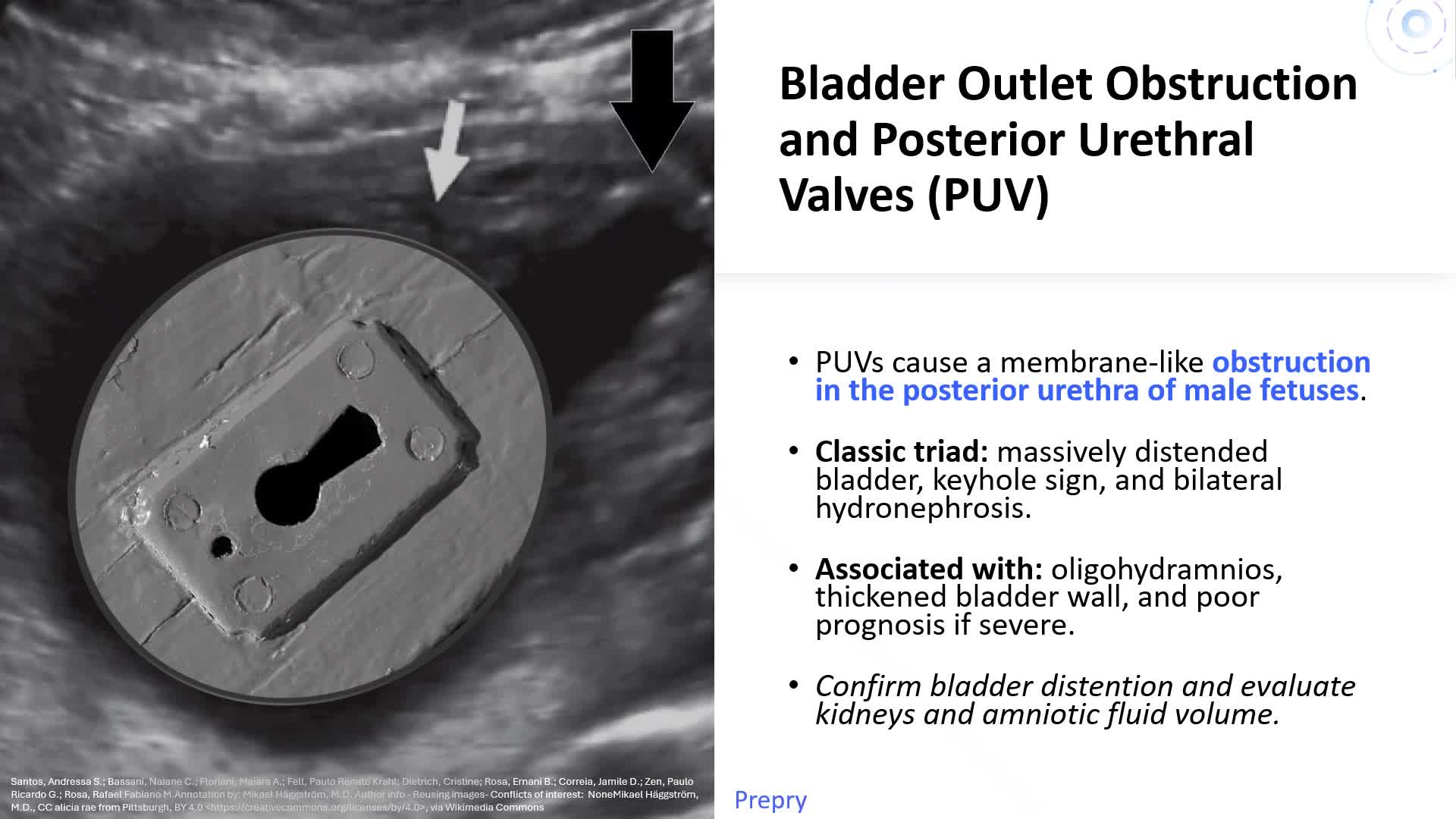
- Fetal kidneys become the primary source of amniotic fluid by 16 weeks, making oligohydramnios a critical indicator of renal agenesis or posterior urethral valves.
- High-yield ARDMS OB/GYN registry concepts in Genitourinary Abnormalities: fetal genitourinary abnormalities, renal agenesis, fetal hydronephrosis, amniotic fluid index, AFI, posterior urethral valves.
Genitourinary Abnormalities: Registry Exam FAQ
What does Genitourinary Abnormalities cover on the ARDMS OB/GYN registry exam?
Explore fetal renal anatomy and common genitourinary anomalies including hydronephrosis and renal agenesis. Understand the relationship between amniotic fluid volume and renal function while mastering SFU and UTD grading systems for pelvic dilation.
Which high-yield ARDMS OB/GYN topics and keywords are tested in Genitourinary Abnormalities?
Key registry concepts tested in this lesson include fetal genitourinary abnormalities, renal agenesis, fetal hydronephrosis, amniotic fluid index, AFI, posterior urethral valves. Knowing how these concepts appear on clinical images and physics questions helps you avoid common ARDMS OB/GYN exam distractors.
Key Registry Concepts in This Lesson
Full Glossary →Hydronephrosis
Hydronephrosis is dilation of the renal collecting system, seen sonographically as anechoic fluid that separates and fills the central renal sinus echoes. A normal adult renal pelvis measures less than 10 mm in anteroposterior diameter; beyond this, dilation of the pelvis and calyces is considered hydronephrosis. A distended bladder can mimic it, so post-void images are obtained to confirm the finding does not resolve after voiding.
On the exam: Exams test the false-positive trap of a full bladder alongside the renal pelvis and calyceal dilation that defines true hydronephrosis.
Amniotic fluid index
The amniotic fluid index is a semiquantitative estimate of amniotic fluid volume, found by splitting the uterus into four quadrants around the umbilicus, measuring the deepest vertical fluid pocket in each one that holds no cord or fetal parts, and adding the four numbers. Roughly 5 to 24 cm is normal; at or below 5 cm is oligohydramnios, and at or above 24 cm is polyhydramnios.
On the exam: The four-quadrant technique and the 5 cm and 24 cm cutoffs are standard, frequently tested AFI thresholds.
Oligohydramnios
Oligohydramnios is too little amniotic fluid: an amniotic fluid index at or below 5 cm, or a deepest pocket shallower than 2 cm. It can show up in any trimester. Causes include ruptured membranes, placental insufficiency, fetal renal anomalies that reduce urine output, and post-term pregnancy. It is often seen with intrauterine growth restriction and, when prolonged, is associated with pulmonary hypoplasia.
On the exam: Exams pair the numeric AFI and single-pocket cutoffs with fetal renal causes and growth restriction as a classic scenario question.
Transcript
26:43 lessonFetal kidneys become the primary source of amniotic fluid by 16 weeks, making oligohydramnios a critical indicator of renal agenesis or posterior urethral valves. Hydronephrosis is assessed using the anteroposterior renal pelvic diameter.
Ready to Test Your Knowledge?
Practice with hundreds of questions designed to help you pass the OB/GYN Exam.
Get Full Access
Unlock all OB/GYN Exam Prep video lessons plus practice questions.
- All video lessons in this course
- 10,000+ practice questions
- Pass guarantee included
25 free questions per exam plus the Question of the Day. No credit card required.