
How to Study for the SPI in Sonography School (and Can You Take It Before Graduating?)
Short answer: Study for the SPI alongside your physics course, not after it: answer a short set of questions on each unit while it's fresh, use spaced review to keep earlier units alive, and switch to full timed mocks in the final weeks. And yes, you can take the SPI before you graduate. The ARDMS® "SPI Requirement, Early Entry" pathway lets you apply once you've passed a qualifying physics course with a C or above, or earned 12 accepted physics CME credits (Inteleos prerequisites PDF).
Below are the official details on testing early, then a practical study plan for doing it while you're juggling classes and clinicals.
Can I take the SPI before graduating?
Yes. ARDMS is now part of Inteleos (ardms.org redirects to inteleos.org), and its SPI and specialty prerequisites document, linked from the Inteleos prerequisites page, describes three routes that let students test before finishing their program.
Route
Who it's for
Key requirements
What it covers
SPI Requirement, Early Entry
Students who have completed a qualifying physics course
Graded college or post-secondary physics course, grade C or above; course title must include "Physics," "Physical Principles" and/or "Instrumentation"; unofficial transcripts accepted. Or a CME certificate with at least 12 ARDMS-accepted physics credits earned within 2 years. No Clinical Verification form needed
SPI only
Pathway 2, Student (Paperless)
Students in an accredited program whose Program Director uses the Paperless Prerequisite 2 Application Program
Apply up to 60 days before graduation through your Program Director
SPI and specialty exams
Pathway 3B, Student
Students in a sonography or vascular technology bachelor's program
Apply up to one year before completion, if 12 months of full-time clinical experience within the program is already done
SPI and specialty exams
Source for all rows: Inteleos SPI & Specialty Exam Prerequisites.
A few details from the same document are worth knowing before you apply:
Early Entry is a limited pathway. It qualifies you for the SPI only. Inteleos notes that if the SPI is your first exam and you can already qualify under a full prerequisite pathway, applying that way is recommended because future application processing will be faster.
Paperless student results depend on graduating. Students who apply before graduation through the Paperless Prerequisite 2 process must successfully complete their program to keep any passed results, and results or certifications can be rescinded if the program isn't completed.
Requirements must be met before you apply. All listed items for your pathway must be completed before you submit the application.
Inteleos also offers an online Prerequisite Prep Tool, linked from the prerequisites page, and your Program Director is the best person to confirm which route fits you.
Should you take the SPI early?
Testing while physics is fresh has a clear upside: the material you just learned is the material on the exam. There's also a timing rule to keep in mind. Your SPI and specialty exam must be passed within 5 years of each other, and the window starts the day after you pass your first exam (Inteleos 5-year rule). Taking the SPI in school starts that clock, which is rarely a problem for students who plan to sit a specialty soon after graduating.
If you're in an echo or vascular program and considering a CCI® credential instead of, or in addition to, an ARDMS credential, check that exam's own requirements, since the ARDMS early entry rules above apply to ARDMS exams.
SPI facts at a glance
Detail
Official answer
Questions and time
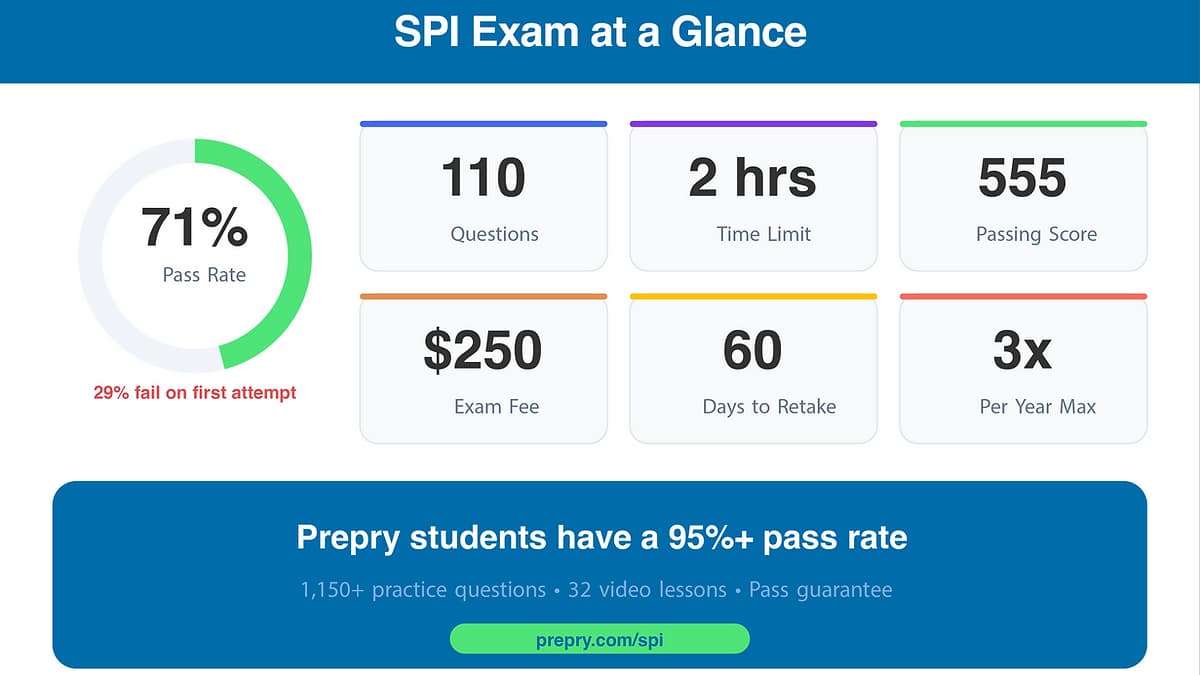
About 110 questions in 2 hours
Fee
$275
Passing score
555 on a 300 to 700 scale; not percentage or curve based
Retake
Reapply after 3 days, retest after 60 days
Source: Inteleos SPI exam page. The $275 fee includes a $100 non-refundable processing fee (fee schedule).
How to study for the SPI while still in school
1. Map your physics syllabus to the SPI outline
Pull up the SPI v24.1 content outline and match each unit of your physics course to a domain.
SPI v24.1 domain
Weight
Apply Doppler Concepts
34%
Optimize Sonographic Images
26%
Perform Ultrasound Examinations
23%
Provide Clinical Safety & Quality Assurance
10%
Manage Ultrasound Transducers
7%
Doppler and image optimization make up 60% of the exam. If your course covers them late in the term, start extra practice on them early.
2. Practice each unit while it's fresh
After each lecture or chapter, answer a short set of SPI questions on that topic. This does double duty: it helps on your class exams and banks progress for the SPI. Read every explanation, including the questions you got right.
3. Keep old units alive with spaced review
By the end of the term, unit one will feel distant. Spaced review solves this by bringing back questions you missed or found hard, while pushing back the ones you know well. Do a few minutes of review on earlier units each week, even when you're busy with the current one.
4. Connect physics to clinicals
Every time you adjust gain, depth, focus or a Doppler angle on a real patient, ask yourself what's happening physically. Clinicals are free SPI practice if you treat them that way.
5. Shift to timed mocks near your test date
In the final weeks, take full-length timed practice exams in one sitting. Review every miss, group them by domain, and spend your next sessions on the weakest one. Watch the trend across several mocks, not any single score.
6. Protect a realistic schedule
School is already a full load. Here's a sample week you can adjust; it's a suggestion, not a rule:
Day
SPI work
Class days
One short question set on the current unit (15 to 20 minutes)
Clinical days
A few minutes of review on your phone
One day off
A longer session: a full topic, or a timed mock in the final weeks
One day
Rest
Using an app during school
Short sessions fit a student schedule best, so a mobile study app helps. Prepry is one option: its Study Blocks divide the Physics/SPI bank into 25-question topic blocks you can take as a quiz or flashcards, with Again, Hard, Good and Easy ratings that decide when each question returns, and its Exam Simulator runs timed practice exams broken down by the official outline.
FAQ
Can I take the SPI before graduating? Yes. Under the SPI Requirement, Early Entry pathway, you can apply after passing a qualifying physics course with a grade of C or above, or with at least 12 ARDMS-accepted physics CME credits earned within 2 years (prerequisites PDF).
Do I need a Clinical Verification form to take the SPI early? No. The prerequisites document states the Clinical Verification form is not required for the SPI examination under the Early Entry pathway.
Can I take my specialty exam before graduating too? Possibly. Students in programs using the Paperless Prerequisite 2 Application Program can apply up to 60 days before graduation, and Pathway 3B students can apply up to one year before completion if they've finished 12 months of full-time clinical experience in the program. Early Entry itself covers the SPI only.
What if I pass the SPI in school but don't take a specialty for a while? The SPI and specialty must be passed within 5 years of each other, starting the day after your first pass (5-year rule).
What score do I need to pass? 555 on a 300 to 700 scale. It isn't a percentage or curve (Inteleos SPI page).
ARDMS® and CCI® are registered trademarks of their respective owners and do not endorse Prepry.

Michael Zaladonis, MBA, RVT
Founder & CEO
With over 10 years of app development experience and 15 years in vascular sonography, Michael founded Imago AI LLC to create innovative medical education applications. As creator of Prepry, a registry review app used by 130,000+ students, his mission is to empower ultrasound professionals through top-tier education and technology.
More from the Blog
Keep reading with these related articles
Related Exam Resources
Prepare for your certification with Prepry

