
Biophysical ProfileBPP Scoring & Amniotic Fluid Index (ARDMS OB/GYN)
Biophysical Profile
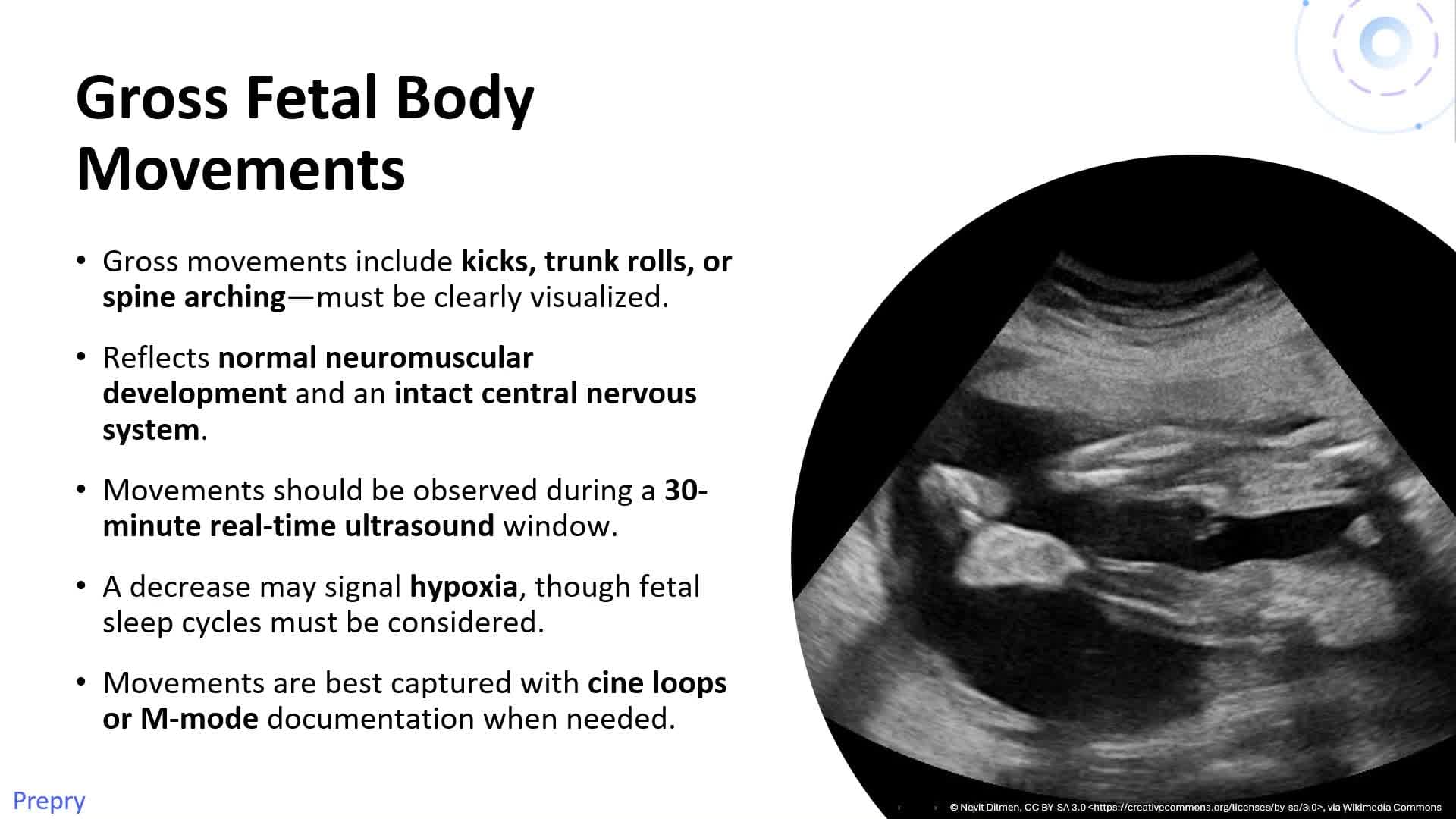
Evaluate fetal health using the biophysical profile scoring system, including amniotic fluid index, fetal breathing, and gross body movements. Understand the clinical significance of BPP scores in identifying placental insufficiency and fetal hypoxia. ARDMS, ARRT, and CCI registry exam preparation.
Lesson Overview & Exam Focus
Evaluate fetal health using the biophysical profile scoring system, including amniotic fluid index, fetal breathing, and gross body movements. Understand the clinical significance of BPP scores in identifying placental insufficiency and fetal hypoxia. ARDMS, ARRT, and CCI registry exam preparation.
Key Exam Takeaways & Study Notes
- Evaluate fetal health using the biophysical profile scoring system, including amniotic fluid index, fetal breathing, and gross body movements.
- Understand the clinical significance of BPP scores in identifying placental insufficiency and fetal hypoxia.
- The biophysical profile assesses fetal wellbeing through four sonographic parameters: fetal breathing, movement, tone, and amniotic fluid volume.
- High-yield ARDMS OB/GYN registry concepts in Biophysical Profile: biophysical profile, BPP scoring, amniotic fluid index, AFI, fetal breathing movements, fetal tone.
Biophysical Profile: Registry Exam FAQ
What does Biophysical Profile cover on the ARDMS OB/GYN registry exam?
Evaluate fetal health using the biophysical profile scoring system, including amniotic fluid index, fetal breathing, and gross body movements. Understand the clinical significance of BPP scores in identifying placental insufficiency and fetal hypoxia.
Which high-yield ARDMS OB/GYN topics and keywords are tested in Biophysical Profile?
Key registry concepts tested in this lesson include biophysical profile, BPP scoring, amniotic fluid index, AFI, fetal breathing movements, fetal tone. Knowing how these concepts appear on clinical images and physics questions helps you avoid common ARDMS OB/GYN exam distractors.
Key Registry Concepts in This Lesson
Full Glossary →Amniotic fluid index
The amniotic fluid index is a semiquantitative estimate of amniotic fluid volume, found by splitting the uterus into four quadrants around the umbilicus, measuring the deepest vertical fluid pocket in each one that holds no cord or fetal parts, and adding the four numbers. Roughly 5 to 24 cm is normal; at or below 5 cm is oligohydramnios, and at or above 24 cm is polyhydramnios.
On the exam: The four-quadrant technique and the 5 cm and 24 cm cutoffs are standard, frequently tested AFI thresholds.
Oligohydramnios
Oligohydramnios is too little amniotic fluid: an amniotic fluid index at or below 5 cm, or a deepest pocket shallower than 2 cm. It can show up in any trimester. Causes include ruptured membranes, placental insufficiency, fetal renal anomalies that reduce urine output, and post-term pregnancy. It is often seen with intrauterine growth restriction and, when prolonged, is associated with pulmonary hypoplasia.
On the exam: Exams pair the numeric AFI and single-pocket cutoffs with fetal renal causes and growth restriction as a classic scenario question.
Polyhydramnios
Polyhydramnios is too much amniotic fluid: an amniotic fluid index at or above 24 cm, or one pocket deeper than 8 cm. It is associated with fetal anomalies that impair swallowing, such as esophageal or duodenal atresia and cervical teratoma, as well as maternal diabetes and multiple gestation. In twin-to-twin transfusion syndrome, the recipient twin develops polyhydramnios while the donor develops oligohydramnios.
On the exam: Exams commonly link polyhydramnios to swallowing-related fetal anomalies and to the recipient twin in twin-to-twin transfusion syndrome.
Transcript
17:00 lessonThe biophysical profile assesses fetal wellbeing through four sonographic parameters: fetal breathing, movement, tone, and amniotic fluid volume. Scoring is binary, where a total of eight points indicates normal oxygenation.
Ready to Test Your Knowledge?
Practice with hundreds of questions designed to help you pass the OB/GYN Exam.
Get Full Access
Unlock all OB/GYN Exam Prep video lessons plus practice questions.
- All video lessons in this course
- 10,000+ practice questions
- Pass guarantee included
25 free questions per exam plus the Question of the Day. No credit card required.