
Why Rad Tech Week Includes November 8
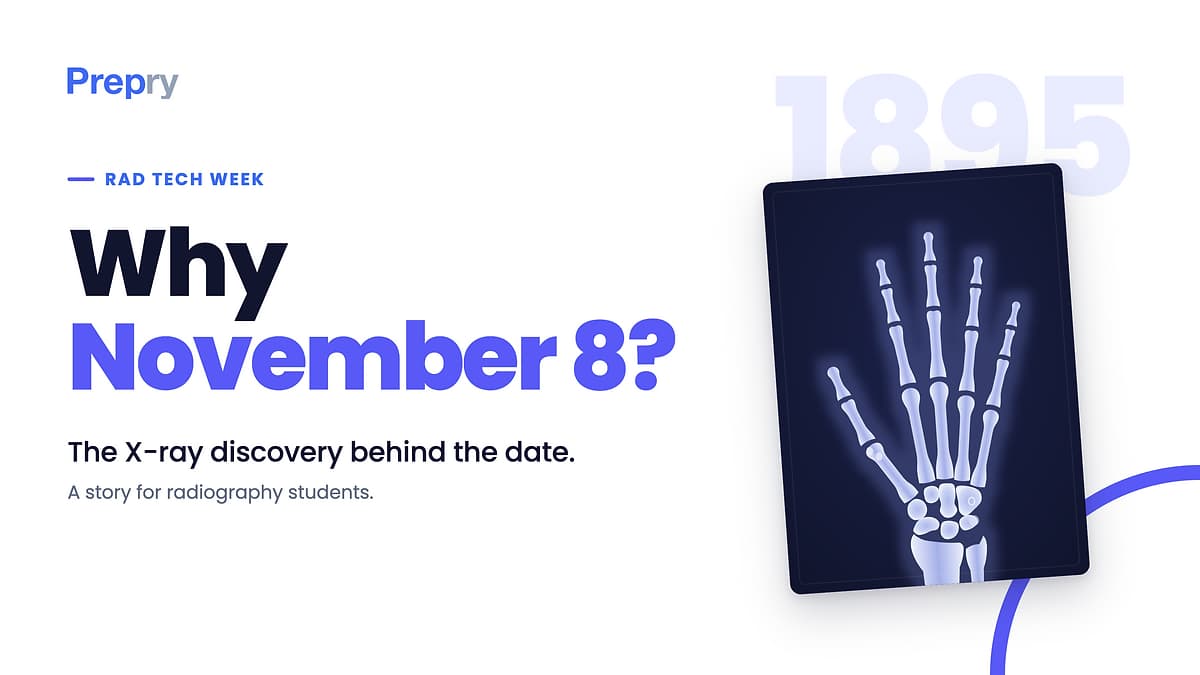
On November 8, 1895, Wilhelm Conrad Röntgen noticed something unexpected in his laboratory in Würzburg, Germany.
He had covered an experimental discharge tube with black cardboard. Yet a nearby fluorescent screen still glowed. Something coming from the tube was passing through the covering and reaching the screen.
Röntgen investigated those invisible rays. His discovery became known as X-rays and opened a new way to see inside the human body.
That anniversary is why National Radiologic Technology Week® includes November 8 each year. In 2026, the celebration runs November 8–14, with the theme “Radiating Love.” ASRT’s annual celebration recognizes the contributions of medical imaging and radiation therapy professionals to patient care and safety.
For radiography students, the history connects directly to the images, equipment, and radiation protection principles you’re learning today.
The hand that made the discovery visible
You may recognize the image: the bones of a hand, with a dark ring around one finger.
Röntgen made that radiograph of his wife Anna Bertha’s hand on December 22, 1895. The Science Museum Group’s collection record documents the image and its date.
The discovery and the famous hand image happened on different days. November 8 marks the discovery of X-rays.
The hand radiograph made the possibilities easier to understand. Structures inside a living person could become visible without surgery. For students learning image production, it also illustrates a concept you’ll study in greater detail: different materials attenuate X-rays differently, creating contrast in the image.
Discovery came before a full understanding of the risks
The early excitement surrounding X-rays came with serious consequences.
Clarence Dally, who worked in Thomas Edison’s laboratory, died in 1904 from radiation injuries sustained during X-ray experiments. The Thomas Edison Papers at Rutgers University records his death.
That history gives radiation protection a human context. Understanding exposure and controlling it became essential to protecting the people receiving examinations and the professionals performing them.
When you study radiation protection, you’re learning principles that support decisions you’ll make throughout your career.
Connect the history to your registry preparation
Radiation protection is part of the knowledge ARRT assesses in radiography.
The Radiography examination content specifications applicable through February 28, 2027 include minimizing patient exposure, beam restriction, exposure factors, personnel protection, and radiation monitoring. Time, distance, and shielding appear as basic methods of personnel protection.
Testing on or after March 1, 2027? ARRT has updated Radiography content specifications for those exam dates. Check the official examination content specifications and use the version that applies to your exam.
To mark the anniversary, try one focused review session:
Choose a radiation protection topic you find difficult.
Answer a short set of practice questions.
Review the explanations, including why the other answers are incorrect.
Bring any unresolved questions to your instructor.
Keep the session manageable. The goal is to leave with a clearer understanding of one topic and a specific next step.
Prepry’s radiography practice questions can help you identify topics that need another look.
Recognize the people helping you learn
There’s another way to mark the week: thank a technologist or clinical instructor for a specific lesson.
Perhaps they explained a positioning adjustment until it made sense. Perhaps they showed you how to communicate calmly with a nervous patient. Perhaps their feedback helped you recognize a mistake and improve.
Tell them what stayed with you.
The discovery explains the date. The professionals caring for patients and teaching the next generation give the week its purpose.
From all of us at Prepry, happy National Radiologic Technology Week to the technologists, educators, clinical instructors, and students helping carry the profession forward.

Prepry
More from the Blog
Keep reading with these related articles
Related Exam Resources
Prepare for your certification with Prepry

