
Abdominal Transplants and Postoperative Assessment - Part 1Liver Transplant & Pancreas Transplant (ARDMS Abdomen)
Abdominal Transplants and Postoperative Assessment - Part 1
Explore sonographic evaluation of liver, kidney, and pancreas transplants including preoperative vascular mapping and postoperative monitoring. Master Doppler techniques for assessing hepatic artery patency, resistive index values, and identifying complications like thrombosis. ARDMS, ARRT, and CCI registry exam preparation.
Lesson Overview & Exam Focus
Explore sonographic evaluation of liver, kidney, and pancreas transplants including preoperative vascular mapping and postoperative monitoring. Master Doppler techniques for assessing hepatic artery patency, resistive index values, and identifying complications like thrombosis. ARDMS, ARRT, and CCI registry exam preparation.
Key Exam Takeaways & Study Notes
- Explore sonographic evaluation of liver, kidney, and pancreas transplants including preoperative vascular mapping and postoperative monitoring.
- Master Doppler techniques for assessing hepatic artery patency, resistive index values, and identifying complications like thrombosis.
- Preoperative ultrasound assesses organ echo texture and portal hypertension.
- High-yield ARDMS Abdomen registry concepts in Abdominal Transplants and Postoperative Assessment - Part 1: abdominal transplant ultrasound, liver transplant sonography, kidney transplant evaluation, pancreas transplant, hepatic artery thrombosis, resistive index.
Abdominal Transplants and Postoperative Assessment - Part 1: Registry Exam FAQ
What does Abdominal Transplants and Postoperative Assessment - Part 1 cover on the ARDMS Abdomen registry exam?
Explore sonographic evaluation of liver, kidney, and pancreas transplants including preoperative vascular mapping and postoperative monitoring. Master Doppler techniques for assessing hepatic artery patency, resistive index values, and identifying complications like thrombosis.
Which high-yield ARDMS Abdomen topics and keywords are tested in Abdominal Transplants and Postoperative Assessment - Part 1?
Key registry concepts tested in this lesson include abdominal transplant ultrasound, liver transplant sonography, kidney transplant evaluation, pancreas transplant, hepatic artery thrombosis, resistive index. Knowing how these concepts appear on clinical images and physics questions helps you avoid common ARDMS Abdomen exam distractors.
Key Registry Concepts in This Lesson
Full Glossary →Resistive index
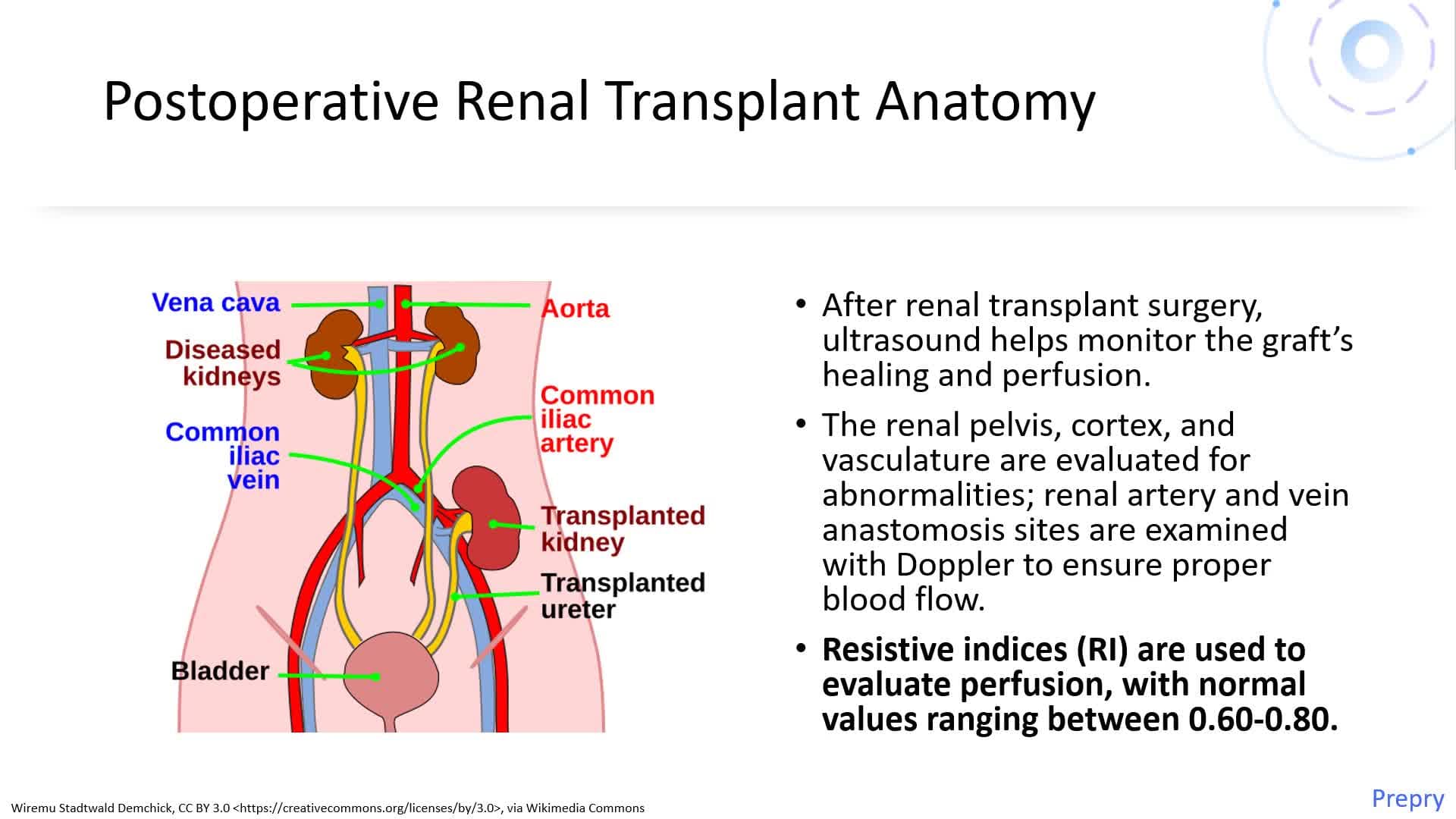
Resistive index, or RI, is a Doppler measurement of downstream resistance to flow, calculated as peak systolic velocity minus end-diastolic velocity, divided by peak systolic velocity. A higher RI reflects greater downstream resistance with little or no diastolic flow, while a lower RI reflects a low-resistance bed with substantial forward flow through diastole. The normal renal artery RI is roughly 0.47 to 0.70, and a renal transplant RI above about 0.8 raises concern for transplant dysfunction.
On the exam: Abdomen and vascular questions give PSV and EDV and ask you to calculate RI, then compare it to a threshold such as 0.8 for renal transplant dysfunction.
Portal hypertension
Portal hypertension is elevated pressure in the portal venous system, defined as a portal pressure gradient above 5 mm Hg. Cirrhosis is the most common cause in the United States. Ultrasound findings include splenomegaly, ascites, portosystemic collaterals and a portal vein wider than about 13 mm, though width alone is unreliable. Flow direction tells the story: blood normally runs toward the liver (hepatopetal), and reversed flow away from it (hepatofugal) indicates portal hypertension. A serious complication is acute variceal bleeding.
On the exam: Registry questions test hepatofugal versus hepatopetal flow direction as the classic Doppler sign of portal hypertension, along with splenomegaly as its most dependable clinical indicator.
Transcript
26:21 lessonPreoperative ultrasound assesses organ echo texture and portal hypertension. Postoperative Doppler monitoring focuses on vascular anastomosis sites to detect hepatic artery thrombosis and graft loss.
Ready to Test Your Knowledge?
Practice with hundreds of questions designed to help you pass the Abdomen Exam.
Get Full Access
Unlock all Abdomen Exam Prep video lessons plus practice questions.
- All video lessons in this course
- 10,000+ practice questions
- Pass guarantee included
25 free questions per exam plus the Question of the Day. No credit card required.