
Ultrasound Carotid Following Surgery and InterventionCarotid Endarterectomy & CEA (ARDMS RVT)
Ultrasound Carotid Following Surgery and Intervention
Learn to evaluate carotid endarterectomy (CEA) sites and identify complications like neointimal hyperplasia or patch failure. Master ultrasound protocols for synthetic and autogenous patches to detect re-stenosis and intimal flaps. ARDMS, ARRT, and CCI registry exam preparation.
Lesson Overview & Exam Focus
Learn to evaluate carotid endarterectomy (CEA) sites and identify complications like neointimal hyperplasia or patch failure. Master ultrasound protocols for synthetic and autogenous patches to detect re-stenosis and intimal flaps. ARDMS, ARRT, and CCI registry exam preparation.
Key Exam Takeaways & Study Notes
- Learn to evaluate carotid endarterectomy (CEA) sites and identify complications like neointimal hyperplasia or patch failure.
- Master ultrasound protocols for synthetic and autogenous patches to detect re-stenosis and intimal flaps.
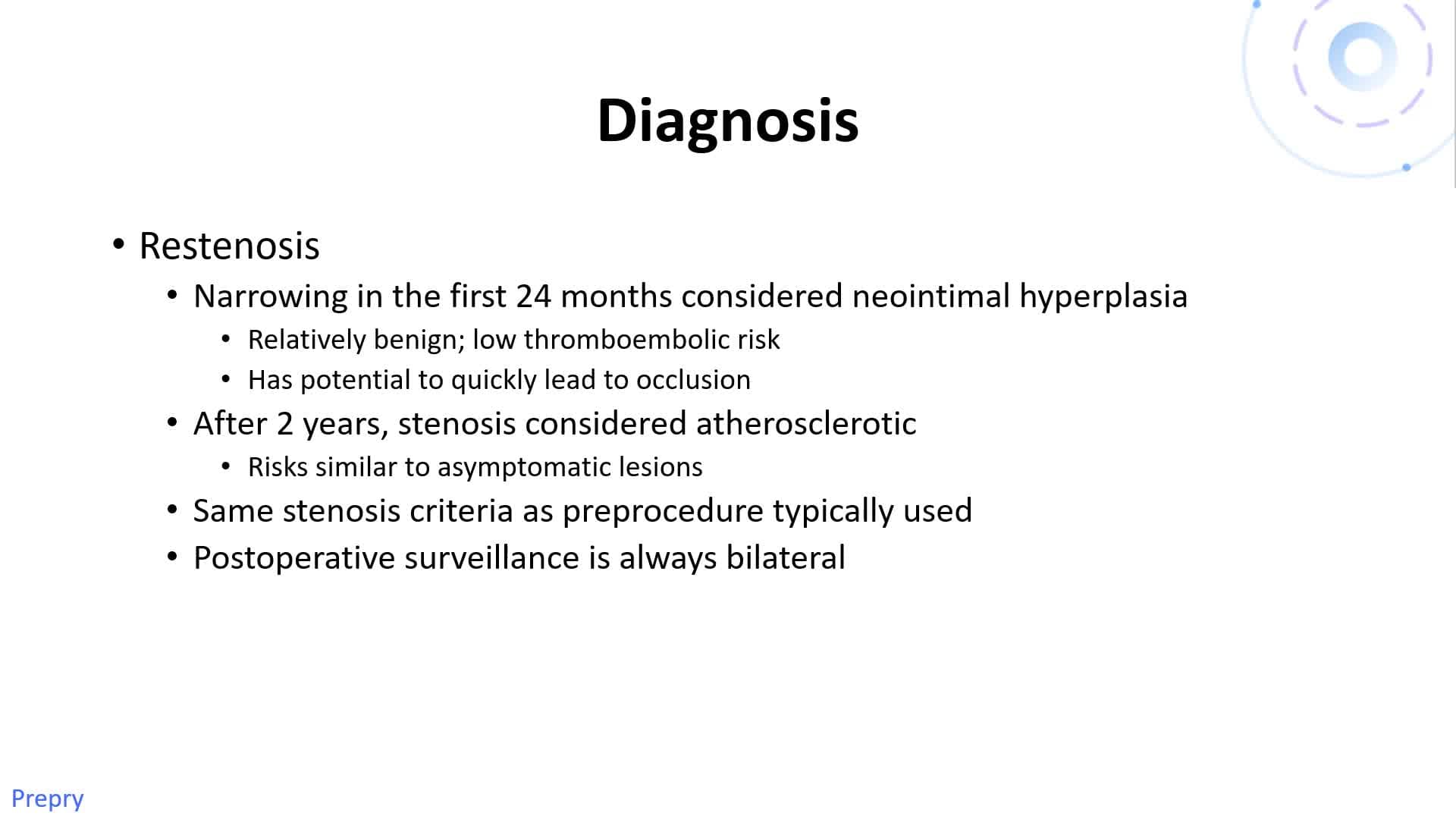
- Carotid endarterectomy sites are assessed for neointimal hyperplasia, typically occurring within six to twelve months post-surgery.
- High-yield ARDMS RVT registry concepts in Ultrasound Carotid Following Surgery and Intervention: carotid endarterectomy, CEA, neointimal hyperplasia, carotid stent, vascular ultrasound, ARDMS exam prep.
Ultrasound Carotid Following Surgery and Intervention: Registry Exam FAQ
What does Ultrasound Carotid Following Surgery and Intervention cover on the ARDMS RVT registry exam?
Learn to evaluate carotid endarterectomy (CEA) sites and identify complications like neointimal hyperplasia or patch failure. Master ultrasound protocols for synthetic and autogenous patches to detect re-stenosis and intimal flaps.
Which high-yield ARDMS RVT topics and keywords are tested in Ultrasound Carotid Following Surgery and Intervention?
Key registry concepts tested in this lesson include carotid endarterectomy, CEA, neointimal hyperplasia, carotid stent, vascular ultrasound, ARDMS exam prep. Knowing how these concepts appear on clinical images and physics questions helps you avoid common ARDMS RVT exam distractors.
Key Registry Concepts in This Lesson
Full Glossary →Intimal flap
An intimal flap is a mobile piece of the innermost arterial layer that has separated from the vessel wall, the defining sign of arterial dissection. On ultrasound it appears as a thin, echogenic line that may flutter with the pulse, separating true and false lumens, with color Doppler often showing different flow patterns on either side. After carotid endarterectomy, a flap longer than 2 mm on B-mode is considered significant enough to warrant surgical revision.
On the exam: Exams test recognition of an intimal flap as the defining sonographic sign of dissection, and the 2 mm threshold for revision after carotid endarterectomy.
Pseudoaneurysm
A pseudoaneurysm is a contained collection of blood outside the arterial wall that communicates with the artery through a defect, most often from arterial laceration at a catheterization or biopsy access site, held together by surrounding tissue rather than a true vessel wall. Color Doppler classically shows a swirling yin-yang pattern of flow within the sac, and spectral Doppler of the connecting neck shows a to-and-fro waveform as blood moves into the sac in systole and back in diastole.
On the exam: The yin-yang sac pattern and to-and-fro neck waveform are the two classic Doppler findings tested for pseudoaneurysm.
Transcript
11:26 lessonCarotid endarterectomy sites are assessed for neointimal hyperplasia, typically occurring within six to twelve months post-surgery. Evaluation includes identifying Dacron or PTFE patches and monitoring for intimal flaps.
Ready to Test Your Knowledge?
Practice with hundreds of questions designed to help you pass the Vascular Exam.
Get Full Access
Unlock all Vascular Exam Prep video lessons plus practice questions.
- All video lessons in this course
- 10,000+ practice questions
- Pass guarantee included
25 free questions per exam plus the Question of the Day. No credit card required.