
US Physics, Understanding Artifacts and Optimizing Image Quality Pt 1OB/GYN & Propagation Speed (ARDMS OB/GYN)
US Physics, Understanding Artifacts and Optimizing Image Quality Pt 1
Explore fundamental ultrasound physics principles including sound wave behavior and propagation speed in soft tissue. Master the relationship between frequency, wavelength, and attenuation to optimize OB/GYN image quality and spatial resolution. ARDMS, ARRT, and CCI registry exam preparation.
Lesson Overview & Exam Focus
Explore fundamental ultrasound physics principles including sound wave behavior and propagation speed in soft tissue. Master the relationship between frequency, wavelength, and attenuation to optimize OB/GYN image quality and spatial resolution. ARDMS, ARRT, and CCI registry exam preparation.
Key Exam Takeaways & Study Notes
- Explore fundamental ultrasound physics principles including sound wave behavior and propagation speed in soft tissue.
- Master the relationship between frequency, wavelength, and attenuation to optimize OB/GYN image quality and spatial resolution.
- Sound waves are longitudinal mechanical waves traveling through soft tissue at 1,540 m/s.
- High-yield ARDMS OB/GYN registry concepts in US Physics, Understanding Artifacts and Optimizing Image Quality Pt 1: ultrasound physics, OB/GYN ultrasound, propagation speed, sound wave behavior, attenuation, spatial resolution.
US Physics, Understanding Artifacts and Optimizing Image Quality Pt 1: Registry Exam FAQ
What does US Physics, Understanding Artifacts and Optimizing Image Quality Pt 1 cover on the ARDMS OB/GYN registry exam?
Explore fundamental ultrasound physics principles including sound wave behavior and propagation speed in soft tissue. Master the relationship between frequency, wavelength, and attenuation to optimize OB/GYN image quality and spatial resolution.
Which high-yield ARDMS OB/GYN topics and keywords are tested in US Physics, Understanding Artifacts and Optimizing Image Quality Pt 1?
Key registry concepts tested in this lesson include ultrasound physics, OB/GYN ultrasound, propagation speed, sound wave behavior, attenuation, spatial resolution. Knowing how these concepts appear on clinical images and physics questions helps you avoid common ARDMS OB/GYN exam distractors.
Key Registry Concepts in This Lesson
Full Glossary →Propagation speed
Propagation speed is how fast sound travels through a medium, and it depends only on the medium's stiffness and density, not on the transducer. Speed rises with stiffness and falls with density, so sound travels fastest in bone, around 3,500 m/s, and slowest in air, while soft tissue is assumed to average 1,540 m/s. The machine uses that assumed value, together with echo return time, to calculate the depth of a reflector.
On the exam: SPI questions use the 1,540 m/s assumption to test depth calculation, and ask which tissue property, stiffness or density, produces the fastest or slowest propagation speed.
Attenuation
Attenuation is the progressive weakening of an ultrasound beam as it travels through tissue, from absorption, scattering, and reflection. In soft tissue the attenuation coefficient in dB/cm equals half the frequency in MHz, and total attenuation in decibels equals that coefficient multiplied by the path length in cm. Because the coefficient rises with frequency, higher-frequency transducers and deeper structures both lose more signal, which is why raising frequency trades penetration for resolution.
On the exam: SPI questions give a frequency and depth and ask you to solve for the attenuation coefficient or the total attenuation in decibels.
Frequency
Frequency is the number of complete sound wave cycles per second, measured in Hertz, and diagnostic ultrasound uses roughly 2 to 18 MHz. It is set by the transducer and stays constant as sound crosses into a new medium, unlike wavelength, which changes with propagation speed. Higher frequency shortens wavelength and improves resolution, but it also raises scattering and attenuation, which is why higher frequencies penetrate less deeply.
On the exam: SPI questions give a transmitted, fundamental frequency and ask for the second harmonic, which is always double it.
Wavelength
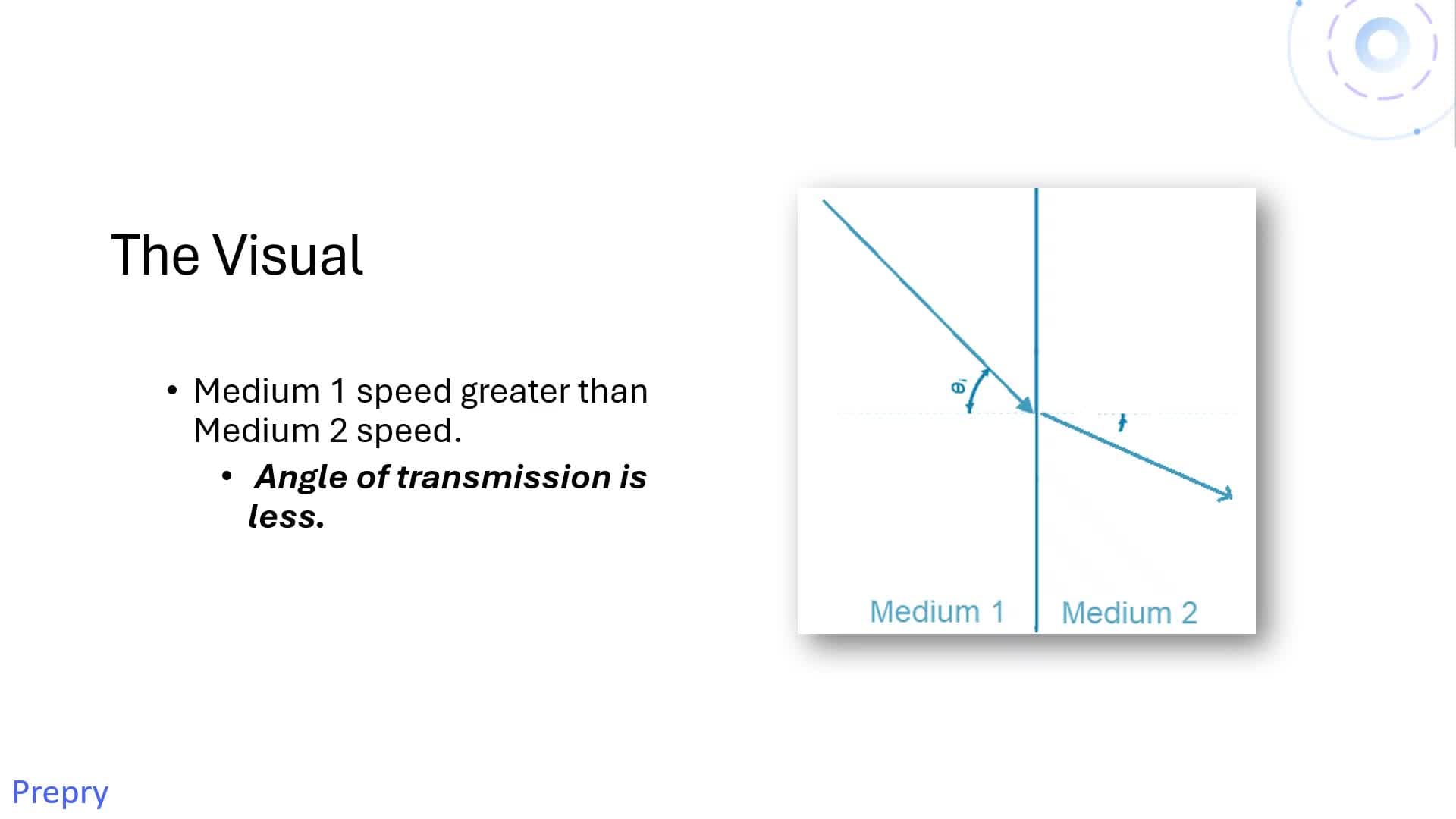
Wavelength is the physical length that one complete cycle of a sound wave occupies, equal to propagation speed divided by frequency. Because frequency is fixed by the transducer, wavelength changes only when propagation speed changes, such as when sound crosses into a different medium; a faster medium stretches the wavelength and a slower one shortens it. In soft tissue, wavelength in millimeters is roughly 1.54 divided by frequency in MHz.
On the exam: SPI questions ask you to solve for wavelength in soft tissue using the 1.54 shortcut, and to recognize that wavelength, not frequency, changes when sound enters a new medium.
Transcript
31:58 lessonSound waves are longitudinal mechanical waves traveling through soft tissue at 1,540 m/s. Frequency and wavelength inversely affect spatial resolution and beam attenuation during fetal imaging.
Ready to Test Your Knowledge?
Practice with hundreds of questions designed to help you pass the OB/GYN Exam.
Get Full Access
Unlock all OB/GYN Exam Prep video lessons plus practice questions.
- All video lessons in this course
- 10,000+ practice questions
- Pass guarantee included
25 free questions per exam plus the Question of the Day. No credit card required.