
Peripheral Arterial Overview and Indirect TestingPlethysmography & Claudication (ARDMS RVT)
Peripheral Arterial Overview and Indirect Testing
Explore indirect physiologic testing methods for peripheral arterial occlusive disease, including plethysmography and systolic pressure measurements. Differentiate between true claudication and conditions like spinal stenosis while mastering patient positioning. ARDMS, ARRT, and CCI registry exam preparation.
Lesson Overview & Exam Focus
Explore indirect physiologic testing methods for peripheral arterial occlusive disease, including plethysmography and systolic pressure measurements. Differentiate between true claudication and conditions like spinal stenosis while mastering patient positioning. ARDMS, ARRT, and CCI registry exam preparation.
Key Exam Takeaways & Study Notes
- Explore indirect physiologic testing methods for peripheral arterial occlusive disease, including plethysmography and systolic pressure measurements.
- Differentiate between true claudication and conditions like spinal stenosis while mastering patient positioning.
- Indirect physiologic testing detects hemodynamically significant disease by evaluating limb perfusion and systolic pressures.
- High-yield ARDMS RVT registry concepts in Peripheral Arterial Overview and Indirect Testing: peripheral arterial disease, indirect testing, plethysmography, claudication, systolic pressure, Doppler waveforms.
Peripheral Arterial Overview and Indirect Testing: Registry Exam FAQ
What does Peripheral Arterial Overview and Indirect Testing cover on the ARDMS RVT registry exam?
Explore indirect physiologic testing methods for peripheral arterial occlusive disease, including plethysmography and systolic pressure measurements. Differentiate between true claudication and conditions like spinal stenosis while mastering patient positioning.
Which high-yield ARDMS RVT topics and keywords are tested in Peripheral Arterial Overview and Indirect Testing?
Key registry concepts tested in this lesson include peripheral arterial disease, indirect testing, plethysmography, claudication, systolic pressure, Doppler waveforms. Knowing how these concepts appear on clinical images and physics questions helps you avoid common ARDMS RVT exam distractors.
Key Registry Concepts in This Lesson
Full Glossary →Continuous wave Doppler
Continuous wave Doppler uses two separate piezoelectric elements, one continuously transmitting and one continuously receiving, so it can measure very high velocities accurately without a Nyquist limit or aliasing. Its major limitation is range ambiguity: because it samples along the entire beam at once rather than in pulses, it cannot localize the depth at which a given Doppler signal arose, giving it the poorest axial resolution of any Doppler mode. It still reports both flow speed and direction.
On the exam: Echo questions test that continuous wave Doppler is chosen over pulsed wave to measure high velocities, such as across a stenotic valve, without aliasing.
Peripheral arterial disease
Peripheral arterial disease is narrowing or occlusion of arteries outside the heart and brain, most often from atherosclerosis in the lower extremities. True intermittent claudication is reproducible pain in a large muscle group brought on by walking and relieved by rest or quiet standing; pain at rest, relieved by dangling the leg, signals more severe disease. Diagnosis relies on the ankle-brachial index and duplex ultrasound, with angiography as the gold standard.
On the exam: PAD questions often connect claudication symptoms to the ankle-brachial index as the standard first-line diagnostic tool.
Transcript
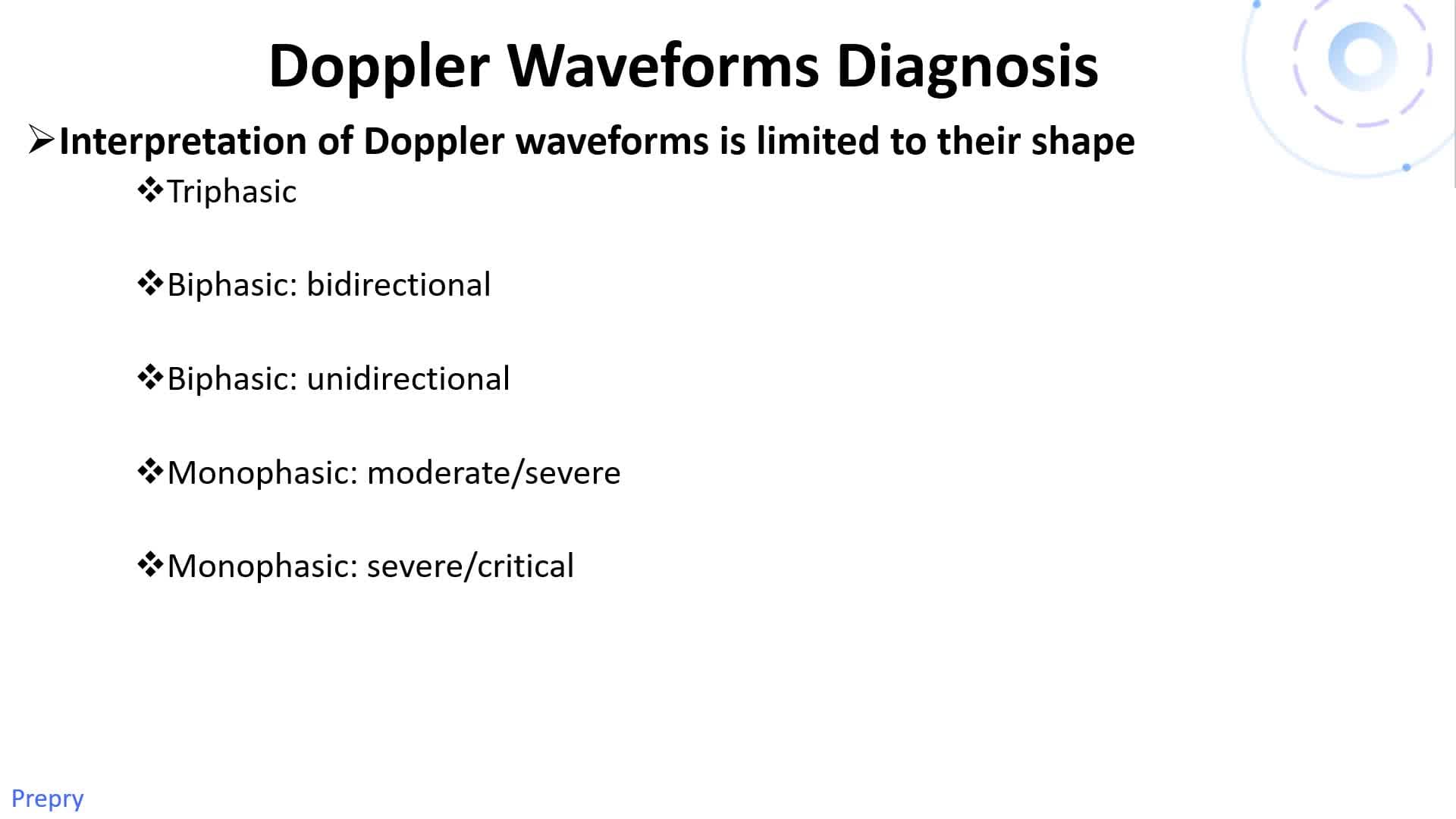
22:36 lessonIndirect physiologic testing detects hemodynamically significant disease by evaluating limb perfusion and systolic pressures. Plethysmography and continuous wave Doppler waveforms help categorize the severity of arterial occlusive disease.
Ready to Test Your Knowledge?
Practice with hundreds of questions designed to help you pass the Vascular Exam.
Get Full Access
Unlock all Vascular Exam Prep video lessons plus practice questions.
- All video lessons in this course
- 10,000+ practice questions
- Pass guarantee included
25 free questions per exam plus the Question of the Day. No credit card required.