
Peripheral Arterial TestingPAOD & Intermittent Claudication (ARDMS RVT)
Peripheral Arterial Testing
Explore duplex scanning techniques for peripheral arterial occlusive disease and intermittent claudication. Learn to differentiate true claudication from spinal stenosis while evaluating plaque characteristics and spectral Doppler waveforms. ARDMS, ARRT, and CCI registry exam preparation.
Lesson Overview & Exam Focus
Explore duplex scanning techniques for peripheral arterial occlusive disease and intermittent claudication. Learn to differentiate true claudication from spinal stenosis while evaluating plaque characteristics and spectral Doppler waveforms. ARDMS, ARRT, and CCI registry exam preparation.
Key Exam Takeaways & Study Notes
- Explore duplex scanning techniques for peripheral arterial occlusive disease and intermittent claudication.
- Learn to differentiate true claudication from spinal stenosis while evaluating plaque characteristics and spectral Doppler waveforms.
- Intermittent claudication presents as reproducible muscle pain, while rest pain indicates advanced PAOD.
- High-yield ARDMS RVT registry concepts in Peripheral Arterial Testing: peripheral arterial testing, PAOD, intermittent claudication, duplex scanning, spectral Doppler, vascular ultrasound.
Peripheral Arterial Testing: Registry Exam FAQ
What does Peripheral Arterial Testing cover on the ARDMS RVT registry exam?
Explore duplex scanning techniques for peripheral arterial occlusive disease and intermittent claudication. Learn to differentiate true claudication from spinal stenosis while evaluating plaque characteristics and spectral Doppler waveforms.
Which high-yield ARDMS RVT topics and keywords are tested in Peripheral Arterial Testing?
Key registry concepts tested in this lesson include peripheral arterial testing, PAOD, intermittent claudication, duplex scanning, spectral Doppler, vascular ultrasound. Knowing how these concepts appear on clinical images and physics questions helps you avoid common ARDMS RVT exam distractors.
Key Registry Concepts in This Lesson
Full Glossary →Color Doppler
Color Doppler overlays a real-time, color-coded map of blood flow direction and mean velocity onto a grayscale image, using pulsed wave Doppler sampled at many points at once rather than the Fast Fourier Transform used for spectral display. By convention, flow toward the transducer is one color, typically red, and flow away is another, typically blue, with brighter shades showing higher mean velocity. It shares the same Nyquist limit and aliasing behavior as pulsed wave spectral Doppler.
On the exam: SPI and vascular questions test the toward-red, away-blue convention and that raising the color scale, which raises the Nyquist limit, can eliminate aliasing.
Peripheral arterial disease
Peripheral arterial disease is narrowing or occlusion of arteries outside the heart and brain, most often from atherosclerosis in the lower extremities. True intermittent claudication is reproducible pain in a large muscle group brought on by walking and relieved by rest or quiet standing; pain at rest, relieved by dangling the leg, signals more severe disease. Diagnosis relies on the ankle-brachial index and duplex ultrasound, with angiography as the gold standard.
On the exam: PAD questions often connect claudication symptoms to the ankle-brachial index as the standard first-line diagnostic tool.
Transcript
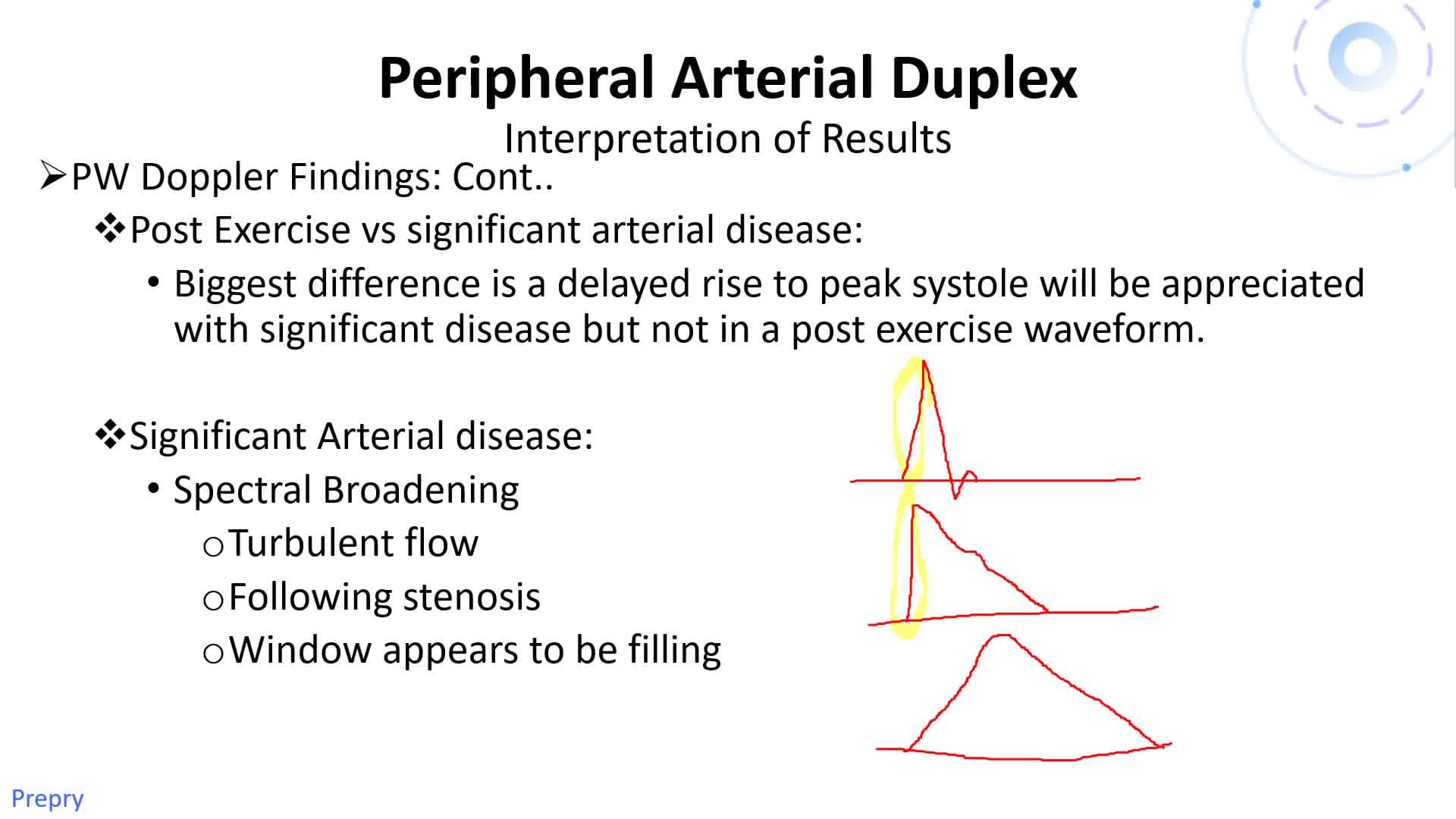
16:01 lessonIntermittent claudication presents as reproducible muscle pain, while rest pain indicates advanced PAOD. Duplex imaging utilizes color Doppler to identify intimal thickening and calcified vessels.
Ready to Test Your Knowledge?
Practice with hundreds of questions designed to help you pass the Vascular Exam.
Get Full Access
Unlock all Vascular Exam Prep video lessons plus practice questions.
- All video lessons in this course
- 10,000+ practice questions
- Pass guarantee included
25 free questions per exam plus the Question of the Day. No credit card required.