
All About ResolutionAxial Resolution & Lateral Resolution (ARDMS SPI)
All About Resolution
Understand the principles of axial and lateral resolution to improve image accuracy in diagnostic studies. Explore how spatial pulse length, frequency, and beam width affect the ability to distinguish between closely spaced reflectors. ARDMS, ARRT, and CCI registry exam preparation.
Lesson Overview & Exam Focus
Understand the principles of axial and lateral resolution to improve image accuracy in diagnostic studies. Explore how spatial pulse length, frequency, and beam width affect the ability to distinguish between closely spaced reflectors. ARDMS, ARRT, and CCI registry exam preparation.
Key Exam Takeaways & Study Notes
- Understand the principles of axial and lateral resolution to improve image accuracy in diagnostic studies.
- Explore how spatial pulse length, frequency, and beam width affect the ability to distinguish between closely spaced reflectors.
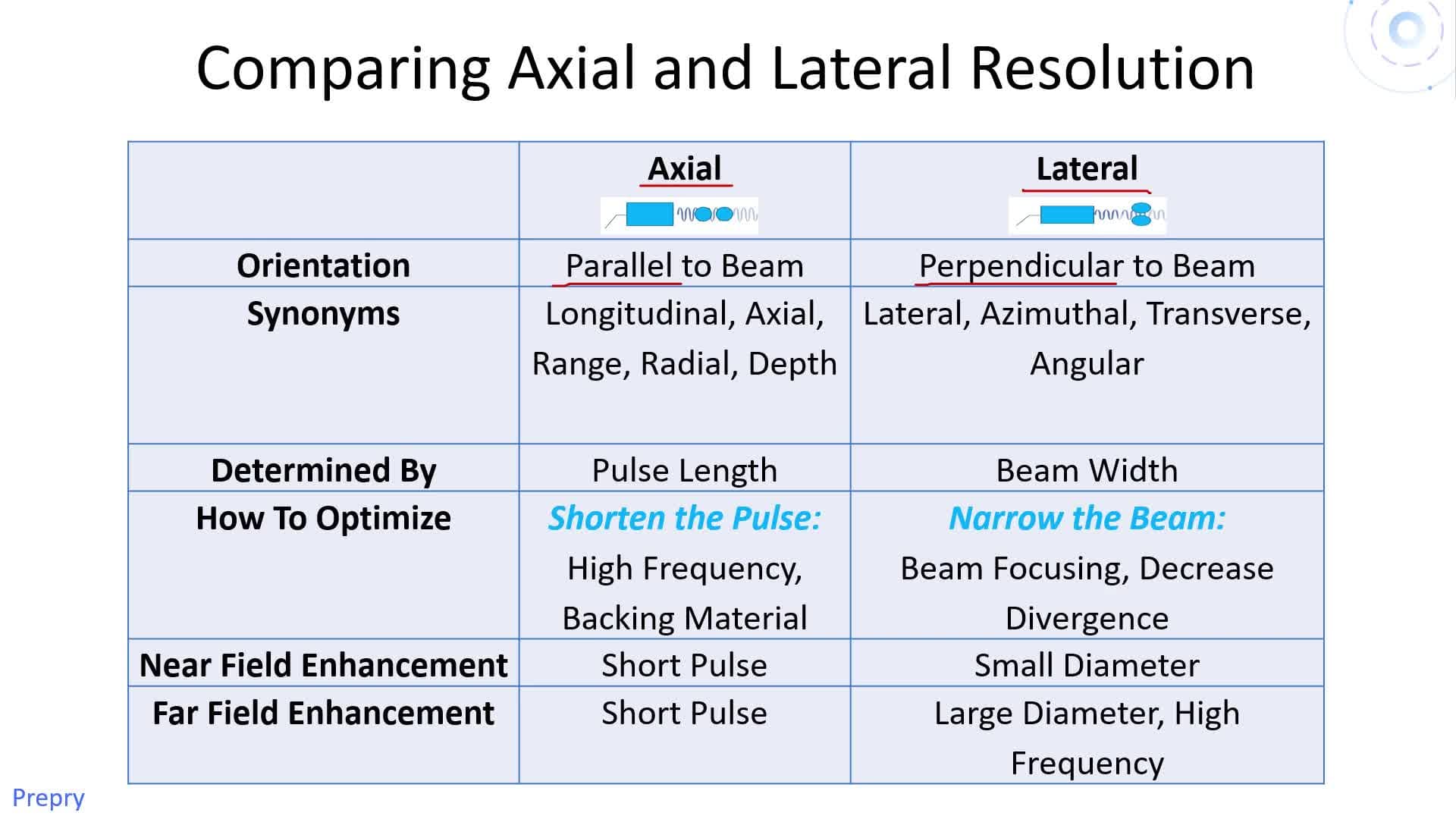
- Axial resolution is determined by half of the spatial pulse length, while lateral resolution depends on the beam width.
- High-yield ARDMS SPI registry concepts in All About Resolution: axial resolution, lateral resolution, spatial pulse length, SPI exam prep, ultrasound physics, LARD mnemonic.
All About Resolution: Registry Exam FAQ
What does All About Resolution cover on the ARDMS SPI registry exam?
Understand the principles of axial and lateral resolution to improve image accuracy in diagnostic studies. Explore how spatial pulse length, frequency, and beam width affect the ability to distinguish between closely spaced reflectors.
Which high-yield ARDMS SPI topics and keywords are tested in All About Resolution?
Key registry concepts tested in this lesson include axial resolution, lateral resolution, spatial pulse length, SPI exam prep, ultrasound physics, LARD mnemonic. Knowing how these concepts appear on clinical images and physics questions helps you avoid common ARDMS SPI exam distractors.
Key Registry Concepts in This Lesson
Full Glossary →Axial resolution
Axial resolution is the ability to display two structures lying one behind the other, along the beam's path, as two separate echoes. It is determined entirely by spatial pulse length, since axial resolution equals spatial pulse length divided by two, so shorter pulses give better, smaller-number resolution. Raising frequency or damping the transducer more heavily shortens the pulse and improves it. The depth of the reflector itself has no effect on axial resolution.
On the exam: SPI questions test that axial resolution depends only on spatial pulse length, not on how deep the reflector lies.
Lateral resolution
Lateral resolution is the ability to display two structures lying side by side, perpendicular to the beam, as two separate echoes, and it is set by the width of the ultrasound beam at a given depth. It is best at the focus, where the beam is narrowest, and worsens in the near and far fields where the beam is wider. Raising frequency and properly placing the focal zone at the depth of interest both narrow the beam and improve lateral resolution.
On the exam: SPI questions test that lateral resolution is best at the focal zone, where the beam is narrowest, not a fixed value like axial resolution.
Frequency
Frequency is the number of complete sound wave cycles per second, measured in Hertz, and diagnostic ultrasound uses roughly 2 to 18 MHz. It is set by the transducer and stays constant as sound crosses into a new medium, unlike wavelength, which changes with propagation speed. Higher frequency shortens wavelength and improves resolution, but it also raises scattering and attenuation, which is why higher frequencies penetrate less deeply.
On the exam: SPI questions give a transmitted, fundamental frequency and ask for the second harmonic, which is always double it.
Spatial pulse length
Spatial pulse length, or SPL, is the physical length of space that one ultrasound pulse occupies, equal to the number of cycles in the pulse multiplied by wavelength. It is set entirely by the transducer and the medium, not by the sonographer or imaging depth, and typically ranges from 0.1 to 1.0 mm clinically. SPL is the only variable that directly sets axial resolution, since axial resolution equals SPL divided by two, so fewer cycles or a shorter wavelength both shorten it.
On the exam: SPI questions ask what happens to spatial pulse length, and therefore axial resolution, when frequency rises or cycles per pulse are reduced through damping.
Transcript
18:12 lessonAxial resolution is determined by half of the spatial pulse length, while lateral resolution depends on the beam width. Shortening pulses through damping optimizes image detail for LARD and LATA parameters.
Ready to Test Your Knowledge?
Practice with hundreds of questions designed to help you pass the SPI Exam.
Get Full Access
Unlock all SPI Exam Prep video lessons plus practice questions.
- All video lessons in this course
- 10,000+ practice questions
- Pass guarantee included
25 free questions per exam plus the Question of the Day. No credit card required.