
All About Sound Waves: Part 1Physics & Acoustic Parameters (ARDMS SPI)
All About Sound Waves: Part 1
Explore the seven acoustic parameters essential for ultrasound physics, including period, frequency, and propagation speed. Understand the critical differences between single sound waves and pulsed sound while mastering operator-adjustable settings like amplitude and intensity. ARDMS, ARRT, and CCI registry exam preparation.
Lesson Overview & Exam Focus
Explore the seven acoustic parameters essential for ultrasound physics, including period, frequency, and propagation speed. Understand the critical differences between single sound waves and pulsed sound while mastering operator-adjustable settings like amplitude and intensity. ARDMS, ARRT, and CCI registry exam preparation.
Key Exam Takeaways & Study Notes
- Explore the seven acoustic parameters essential for ultrasound physics, including period, frequency, and propagation speed.
- Understand the critical differences between single sound waves and pulsed sound while mastering operator-adjustable settings like amplitude and intensity.
- The seven acoustic parameters describe a single sound wave, whereas a pulse represents a collection of cycles traveling together.
- High-yield ARDMS SPI registry concepts in All About Sound Waves: Part 1: ultrasound physics, SPI exam prep, acoustic parameters, sound wave frequency, period and frequency relationship, ultrasound cycles.
All About Sound Waves: Part 1: Registry Exam FAQ
What does All About Sound Waves: Part 1 cover on the ARDMS SPI registry exam?
Explore the seven acoustic parameters essential for ultrasound physics, including period, frequency, and propagation speed. Understand the critical differences between single sound waves and pulsed sound while mastering operator-adjustable settings like amplitude and intensity.
Which high-yield ARDMS SPI topics and keywords are tested in All About Sound Waves: Part 1?
Key registry concepts tested in this lesson include ultrasound physics, SPI exam prep, acoustic parameters, sound wave frequency, period and frequency relationship, ultrasound cycles. Knowing how these concepts appear on clinical images and physics questions helps you avoid common ARDMS SPI exam distractors.
Key Registry Concepts in This Lesson
Full Glossary →Propagation speed
Propagation speed is how fast sound travels through a medium, and it depends only on the medium's stiffness and density, not on the transducer. Speed rises with stiffness and falls with density, so sound travels fastest in bone, around 3,500 m/s, and slowest in air, while soft tissue is assumed to average 1,540 m/s. The machine uses that assumed value, together with echo return time, to calculate the depth of a reflector.
On the exam: SPI questions use the 1,540 m/s assumption to test depth calculation, and ask which tissue property, stiffness or density, produces the fastest or slowest propagation speed.
Frequency
Frequency is the number of complete sound wave cycles per second, measured in Hertz, and diagnostic ultrasound uses roughly 2 to 18 MHz. It is set by the transducer and stays constant as sound crosses into a new medium, unlike wavelength, which changes with propagation speed. Higher frequency shortens wavelength and improves resolution, but it also raises scattering and attenuation, which is why higher frequencies penetrate less deeply.
On the exam: SPI questions give a transmitted, fundamental frequency and ask for the second harmonic, which is always double it.
Wavelength
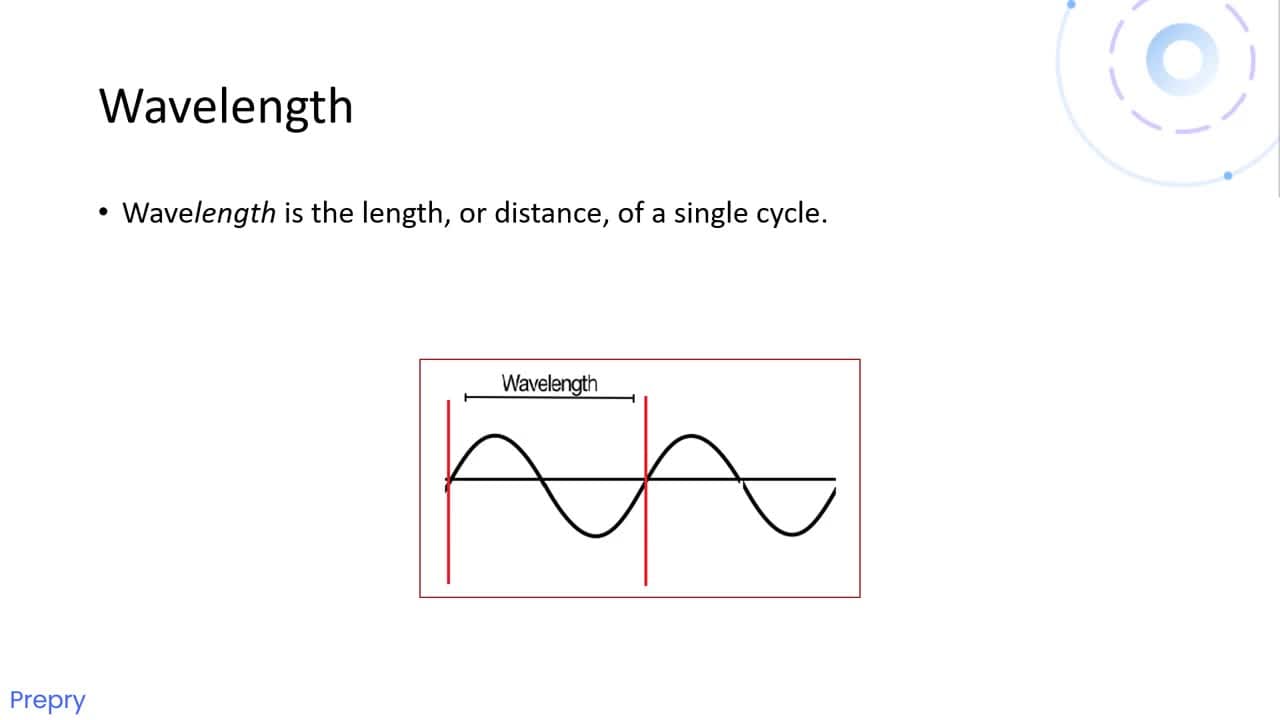
Wavelength is the physical length that one complete cycle of a sound wave occupies, equal to propagation speed divided by frequency. Because frequency is fixed by the transducer, wavelength changes only when propagation speed changes, such as when sound crosses into a different medium; a faster medium stretches the wavelength and a slower one shortens it. In soft tissue, wavelength in millimeters is roughly 1.54 divided by frequency in MHz.
On the exam: SPI questions ask you to solve for wavelength in soft tissue using the 1.54 shortcut, and to recognize that wavelength, not frequency, changes when sound enters a new medium.
Period
Period is the time required to complete one full cycle of a sound wave, usually measured in microseconds, and it equals one divided by frequency. Like frequency, period is fixed by the sound source and does not change when the wave enters a different medium, even though wavelength does. A 5 MHz transducer, for example, produces a period of 0.2 microseconds. Pulse repetition frequency and pulse repetition period are separate, related quantities describing how often pulses are sent.
On the exam: SPI questions test which quantities, like period and frequency, stay constant across media, unlike wavelength, which changes with propagation speed.
Transcript
22:30 lessonThe seven acoustic parameters describe a single sound wave, whereas a pulse represents a collection of cycles traveling together. Period and frequency share an inverse relationship, where frequency is defined as the number of cycles per second measured in Hertz.
Ready to Test Your Knowledge?
Practice with hundreds of questions designed to help you pass the SPI Exam.
Get Full Access
Unlock all SPI Exam Prep video lessons plus practice questions.
- All video lessons in this course
- 10,000+ practice questions
- Pass guarantee included
25 free questions per exam plus the Question of the Day. No credit card required.