
Pulsed UltrasoundARDMS Physics & Pulse Repetition Frequency (ARDMS SPI)
Pulsed Ultrasound
Explore the five pulsed sound parameters including pulse repetition frequency, pulse duration, and spatial pulse length. Understand how imaging depth affects duty factor and why short pulses improve axial resolution for diagnostic imaging. ARDMS, ARRT, and CCI registry exam preparation.
Lesson Overview & Exam Focus
Explore the five pulsed sound parameters including pulse repetition frequency, pulse duration, and spatial pulse length. Understand how imaging depth affects duty factor and why short pulses improve axial resolution for diagnostic imaging. ARDMS, ARRT, and CCI registry exam preparation.
Key Exam Takeaways & Study Notes
- Explore the five pulsed sound parameters including pulse repetition frequency, pulse duration, and spatial pulse length.
- Understand how imaging depth affects duty factor and why short pulses improve axial resolution for diagnostic imaging.
- Pulsed ultrasound consists of a collection of cycles with both transmission time and quiet listening time.
- High-yield ARDMS SPI registry concepts in Pulsed Ultrasound: pulsed ultrasound, SPI exam prep, ARDMS physics, pulse repetition frequency, PRF, pulse repetition period.
Pulsed Ultrasound: Registry Exam FAQ
What does Pulsed Ultrasound cover on the ARDMS SPI registry exam?
Explore the five pulsed sound parameters including pulse repetition frequency, pulse duration, and spatial pulse length. Understand how imaging depth affects duty factor and why short pulses improve axial resolution for diagnostic imaging.
Which high-yield ARDMS SPI topics and keywords are tested in Pulsed Ultrasound?
Key registry concepts tested in this lesson include pulsed ultrasound, SPI exam prep, ARDMS physics, pulse repetition frequency, PRF, pulse repetition period. Knowing how these concepts appear on clinical images and physics questions helps you avoid common ARDMS SPI exam distractors.
Key Registry Concepts in This Lesson
Full Glossary →Axial resolution
Axial resolution is the ability to display two structures lying one behind the other, along the beam's path, as two separate echoes. It is determined entirely by spatial pulse length, since axial resolution equals spatial pulse length divided by two, so shorter pulses give better, smaller-number resolution. Raising frequency or damping the transducer more heavily shortens the pulse and improves it. The depth of the reflector itself has no effect on axial resolution.
On the exam: SPI questions test that axial resolution depends only on spatial pulse length, not on how deep the reflector lies.
Frequency
Frequency is the number of complete sound wave cycles per second, measured in Hertz, and diagnostic ultrasound uses roughly 2 to 18 MHz. It is set by the transducer and stays constant as sound crosses into a new medium, unlike wavelength, which changes with propagation speed. Higher frequency shortens wavelength and improves resolution, but it also raises scattering and attenuation, which is why higher frequencies penetrate less deeply.
On the exam: SPI questions give a transmitted, fundamental frequency and ask for the second harmonic, which is always double it.
Period
Period is the time required to complete one full cycle of a sound wave, usually measured in microseconds, and it equals one divided by frequency. Like frequency, period is fixed by the sound source and does not change when the wave enters a different medium, even though wavelength does. A 5 MHz transducer, for example, produces a period of 0.2 microseconds. Pulse repetition frequency and pulse repetition period are separate, related quantities describing how often pulses are sent.
On the exam: SPI questions test which quantities, like period and frequency, stay constant across media, unlike wavelength, which changes with propagation speed.
Pulse repetition frequency
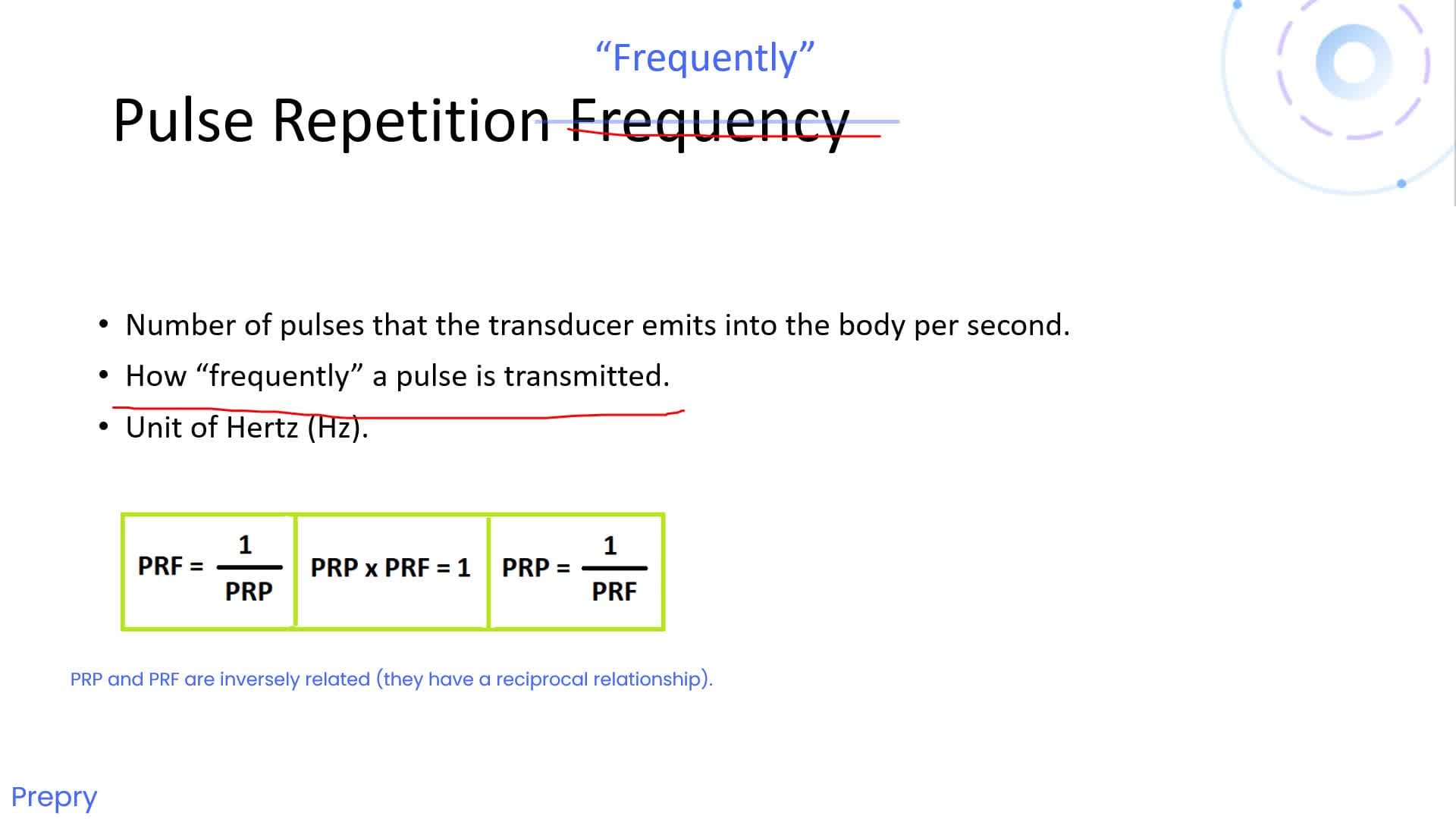
Pulse repetition frequency, or PRF, is the number of ultrasound pulses the transducer sends out each second, and it has a reciprocal relationship with pulse repetition period. PRF is largely set by imaging depth, since the system must wait for echoes to return from the deepest structure before firing the next pulse, so deeper imaging requires a lower PRF. PRF also sets the Nyquist limit, equal to half of PRF, and pushing PRF very high to raise that limit can cause range ambiguity.
On the exam: SPI and vascular questions test that raising imaging depth lowers PRF and the Nyquist limit, while pushing PRF too high to avoid aliasing risks range ambiguity instead.
Transcript
16:30 lessonPulsed ultrasound consists of a collection of cycles with both transmission time and quiet listening time. Parameters like pulse repetition period and frequency are operator adjustable by changing the imaging depth.
Ready to Test Your Knowledge?
Practice with hundreds of questions designed to help you pass the SPI Exam.
Get Full Access
Unlock all SPI Exam Prep video lessons plus practice questions.
- All video lessons in this course
- 10,000+ practice questions
- Pass guarantee included
25 free questions per exam plus the Question of the Day. No credit card required.