
Time of FlightRange Equation & Physics (ARDMS SPI)
Time of Flight
Understand the range equation and time of flight principles used to determine anatomical depth in soft tissue. Calculate imaging depth using the average propagation speed of 1540 m/s and the 13 microsecond rule. ARDMS, ARRT, and CCI registry exam preparation.
Lesson Overview & Exam Focus
Understand the range equation and time of flight principles used to determine anatomical depth in soft tissue. Calculate imaging depth using the average propagation speed of 1540 m/s and the 13 microsecond rule. ARDMS, ARRT, and CCI registry exam preparation.
Key Exam Takeaways & Study Notes
- Understand the range equation and time of flight principles used to determine anatomical depth in soft tissue.
- Calculate imaging depth using the average propagation speed of 1540 m/s and the 13 microsecond rule.
- The range equation calculates reflector depth by multiplying the propagation speed of 1540 meters per second by the go-return time and dividing by two.
- High-yield ARDMS SPI registry concepts in Time of Flight: Time of Flight, Range Equation, Ultrasound Physics, SPI Exam Prep, 13 microsecond rule, Propagation speed.
Time of Flight: Registry Exam FAQ
What does Time of Flight cover on the ARDMS SPI registry exam?
Understand the range equation and time of flight principles used to determine anatomical depth in soft tissue. Calculate imaging depth using the average propagation speed of 1540 m/s and the 13 microsecond rule.
Which high-yield ARDMS SPI topics and keywords are tested in Time of Flight?
Key registry concepts tested in this lesson include Time of Flight, Range Equation, Ultrasound Physics, SPI Exam Prep, 13 microsecond rule, Propagation speed. Knowing how these concepts appear on clinical images and physics questions helps you avoid common ARDMS SPI exam distractors.
Key Registry Concepts in This Lesson
Full Glossary →Propagation speed
Propagation speed is how fast sound travels through a medium, and it depends only on the medium's stiffness and density, not on the transducer. Speed rises with stiffness and falls with density, so sound travels fastest in bone, around 3,500 m/s, and slowest in air, while soft tissue is assumed to average 1,540 m/s. The machine uses that assumed value, together with echo return time, to calculate the depth of a reflector.
On the exam: SPI questions use the 1,540 m/s assumption to test depth calculation, and ask which tissue property, stiffness or density, produces the fastest or slowest propagation speed.
Period
Period is the time required to complete one full cycle of a sound wave, usually measured in microseconds, and it equals one divided by frequency. Like frequency, period is fixed by the sound source and does not change when the wave enters a different medium, even though wavelength does. A 5 MHz transducer, for example, produces a period of 0.2 microseconds. Pulse repetition frequency and pulse repetition period are separate, related quantities describing how often pulses are sent.
On the exam: SPI questions test which quantities, like period and frequency, stay constant across media, unlike wavelength, which changes with propagation speed.
Pulse repetition period
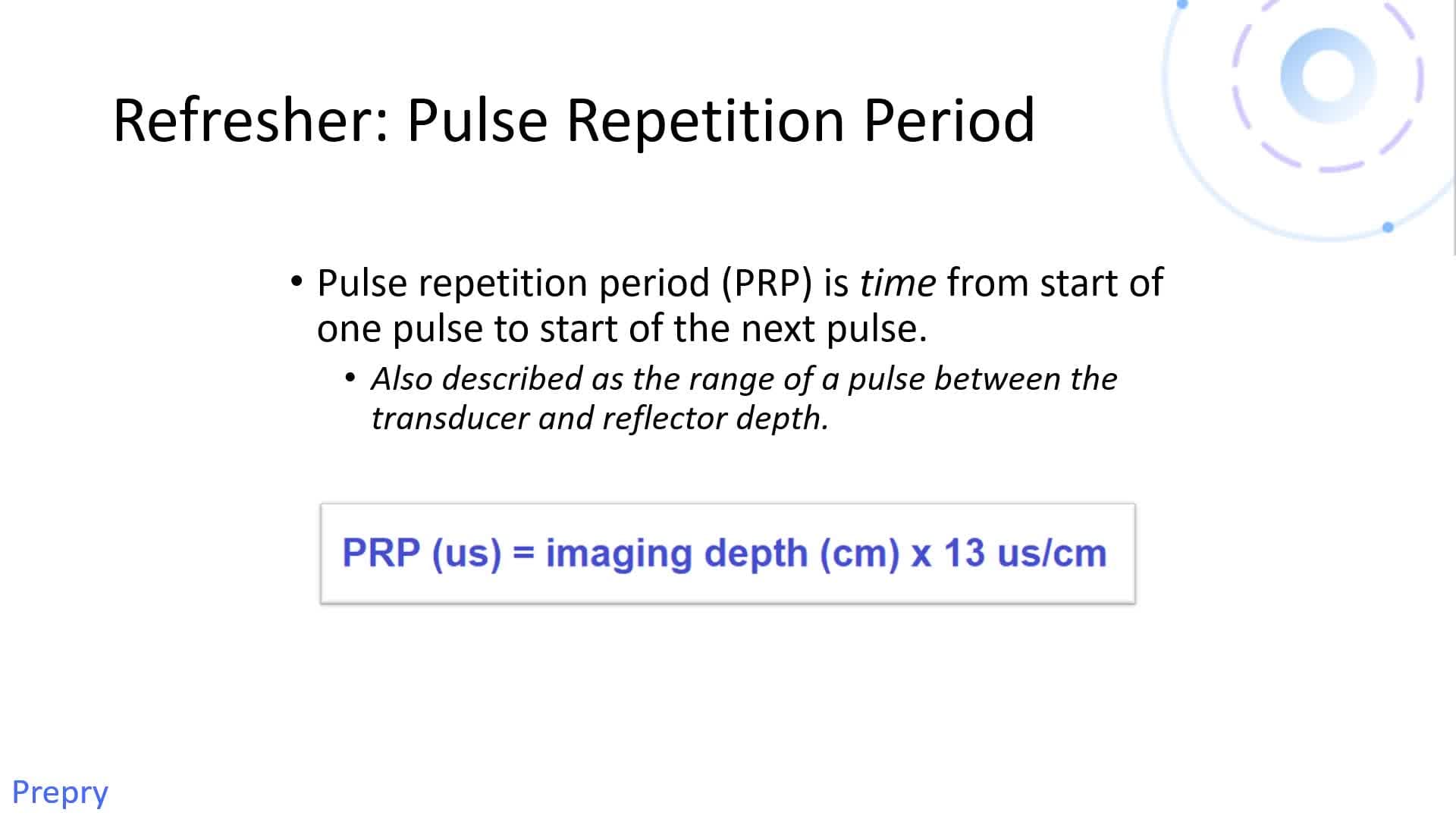
Pulse repetition period, or PRP, is the time from the start of one pulse to the start of the next, and it equals one divided by pulse repetition frequency. PRP is made up of pulse duration, the brief transmit time, plus the much longer listening time spent waiting for echoes to return. Increasing imaging depth lengthens PRP because the system must wait longer for the deepest echoes, while decreasing depth shortens it.
On the exam: SPI questions ask you to calculate PRP from a given PRF, or to identify how imaging depth changes PRP.
Transcript
9:26 lessonThe range equation calculates reflector depth by multiplying the propagation speed of 1540 meters per second by the go-return time and dividing by two. For every 13 microseconds of travel time, sound travels one centimeter deeper.
Ready to Test Your Knowledge?
Practice with hundreds of questions designed to help you pass the SPI Exam.
Get Full Access
Unlock all SPI Exam Prep video lessons plus practice questions.
- All video lessons in this course
- 10,000+ practice questions
- Pass guarantee included
25 free questions per exam plus the Question of the Day. No credit card required.