
Transducer Instrumentation and System Components: Part 2Receiver & Amplification (ARDMS SPI)
Transducer Instrumentation and System Components: Part 2
Explore ultrasound receiver functions including amplification and time gain compensation to optimize image brightness. Understand the critical differences between receiver gain and output power regarding signal-to-noise ratio and ALARA principles. ARDMS, ARRT, and CCI registry exam preparation.
Lesson Overview & Exam Focus
Explore ultrasound receiver functions including amplification and time gain compensation to optimize image brightness. Understand the critical differences between receiver gain and output power regarding signal-to-noise ratio and ALARA principles. ARDMS, ARRT, and CCI registry exam preparation.
Key Exam Takeaways & Study Notes
- Explore ultrasound receiver functions including amplification and time gain compensation to optimize image brightness.
- Understand the critical differences between receiver gain and output power regarding signal-to-noise ratio and ALARA principles.
- The receiver performs five operations in order: amplification, compensation, compression, demodulation, and reject.
- High-yield ARDMS SPI registry concepts in Transducer Instrumentation and System Components: Part 2: ultrasound receiver, amplification, time gain compensation, TGC, signal-to-noise ratio, ALARA principle.
Transducer Instrumentation and System Components: Part 2: Registry Exam FAQ
What does Transducer Instrumentation and System Components: Part 2 cover on the ARDMS SPI registry exam?
Explore ultrasound receiver functions including amplification and time gain compensation to optimize image brightness. Understand the critical differences between receiver gain and output power regarding signal-to-noise ratio and ALARA principles.
Which high-yield ARDMS SPI topics and keywords are tested in Transducer Instrumentation and System Components: Part 2?
Key registry concepts tested in this lesson include ultrasound receiver, amplification, time gain compensation, TGC, signal-to-noise ratio, ALARA principle. Knowing how these concepts appear on clinical images and physics questions helps you avoid common ARDMS SPI exam distractors.
Key Registry Concepts in This Lesson
Full Glossary →Attenuation
Attenuation is the progressive weakening of an ultrasound beam as it travels through tissue, from absorption, scattering, and reflection. In soft tissue the attenuation coefficient in dB/cm equals half the frequency in MHz, and total attenuation in decibels equals that coefficient multiplied by the path length in cm. Because the coefficient rises with frequency, higher-frequency transducers and deeper structures both lose more signal, which is why raising frequency trades penetration for resolution.
On the exam: SPI questions give a frequency and depth and ask you to solve for the attenuation coefficient or the total attenuation in decibels.
Time gain compensation
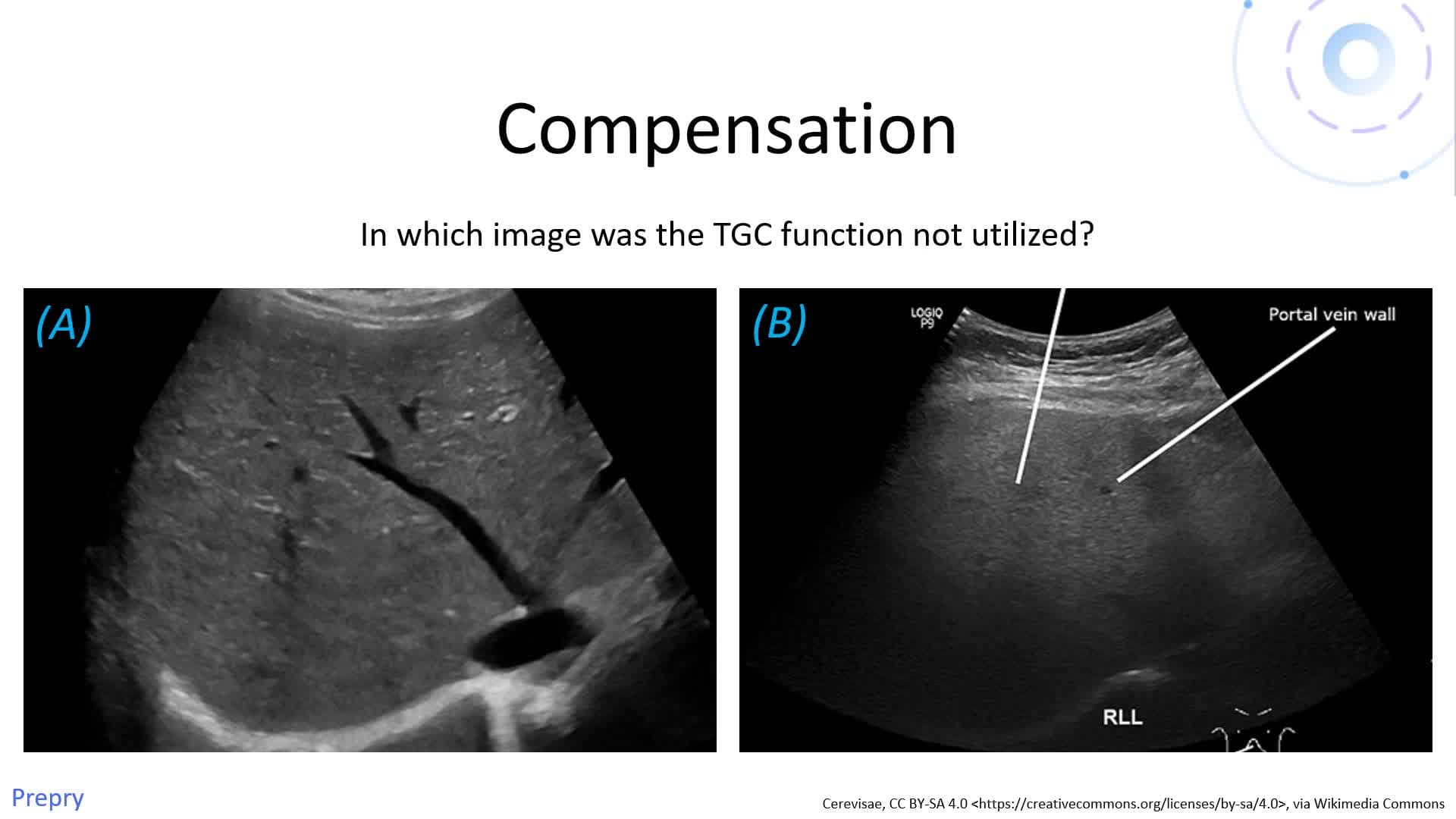
Time gain compensation, or TGC, also called depth gain compensation, amplifies returning echoes according to the depth they came from, boosting deeper echoes more than shallow ones to counteract attenuation. Without it, structures of equal true brightness would look progressively dimmer with depth simply because more sound was lost getting there and back. TGC lets the sonographer adjust this depth-dependent amplification to produce a uniformly bright image.
On the exam: SPI questions test that TGC is a receiver function equalizing brightness by depth, not an adjustment to overall transmit power or gain.
ALARA and cardinal principles of radiation protection
ALARA (As Low As Reasonably Achievable) is the foundational regulatory principle of radiation safety, requiring that every radiation exposure be kept as low as practical while still achieving diagnostic image quality. For occupational protection during fluoroscopy and mobile radiography, ALARA is implemented through three cardinal principles: minimizing exposure time, maximizing distance from the radiation source (the patient in scatter exposure), and using protective lead shielding (typically 0.5 mm lead-equivalent aprons and thyroid collars).
On the exam: ARRT Safety questions test where a technologist should stand during C-arm fluoroscopy (on the image receptor/intensifier side, away from the X-ray tube side where patient entrance scatter is highest) and how time, distance, and shielding reduce occupational dose.
Transcript
11:38 lessonThe receiver performs five operations in order: amplification, compensation, compression, demodulation, and reject. Amplification increases the entire signal brightness, while compensation adjusts for attenuation at depth.
Ready to Test Your Knowledge?
Practice with hundreds of questions designed to help you pass the SPI Exam.
Get Full Access
Unlock all SPI Exam Prep video lessons plus practice questions.
- All video lessons in this course
- 10,000+ practice questions
- Pass guarantee included
25 free questions per exam plus the Question of the Day. No credit card required.