
Attenuation: Part 1Physics & Posterior Shadowing (ARDMS SPI)
Attenuation: Part 1
Explore the principles of ultrasound attenuation, including absorption, reflection, and scattering. Understand how transducer frequency and tissue type affect beam intensity and learn to identify artifacts like posterior shadowing and enhancement. ARDMS, ARRT, and CCI registry exam preparation.
Lesson Overview & Exam Focus
Explore the principles of ultrasound attenuation, including absorption, reflection, and scattering. Understand how transducer frequency and tissue type affect beam intensity and learn to identify artifacts like posterior shadowing and enhancement. ARDMS, ARRT, and CCI registry exam preparation.
Key Exam Takeaways & Study Notes
- Explore the principles of ultrasound attenuation, including absorption, reflection, and scattering.
- Understand how transducer frequency and tissue type affect beam intensity and learn to identify artifacts like posterior shadowing and enhancement.
- Attenuation is the decrease in sound intensity as the acoustic beam propagates through a medium.
- High-yield ARDMS SPI registry concepts in Attenuation: Part 1: attenuation, ultrasound physics, SPI exam prep, ARDMS registry review, posterior shadowing, posterior enhancement.
Attenuation: Part 1: Registry Exam FAQ
What does Attenuation: Part 1 cover on the ARDMS SPI registry exam?
Explore the principles of ultrasound attenuation, including absorption, reflection, and scattering. Understand how transducer frequency and tissue type affect beam intensity and learn to identify artifacts like posterior shadowing and enhancement.
Which high-yield ARDMS SPI topics and keywords are tested in Attenuation: Part 1?
Key registry concepts tested in this lesson include attenuation, ultrasound physics, SPI exam prep, ARDMS registry review, posterior shadowing, posterior enhancement. Knowing how these concepts appear on clinical images and physics questions helps you avoid common ARDMS SPI exam distractors.
Key Registry Concepts in This Lesson
Full Glossary →Propagation speed
Propagation speed is how fast sound travels through a medium, and it depends only on the medium's stiffness and density, not on the transducer. Speed rises with stiffness and falls with density, so sound travels fastest in bone, around 3,500 m/s, and slowest in air, while soft tissue is assumed to average 1,540 m/s. The machine uses that assumed value, together with echo return time, to calculate the depth of a reflector.
On the exam: SPI questions use the 1,540 m/s assumption to test depth calculation, and ask which tissue property, stiffness or density, produces the fastest or slowest propagation speed.
Attenuation
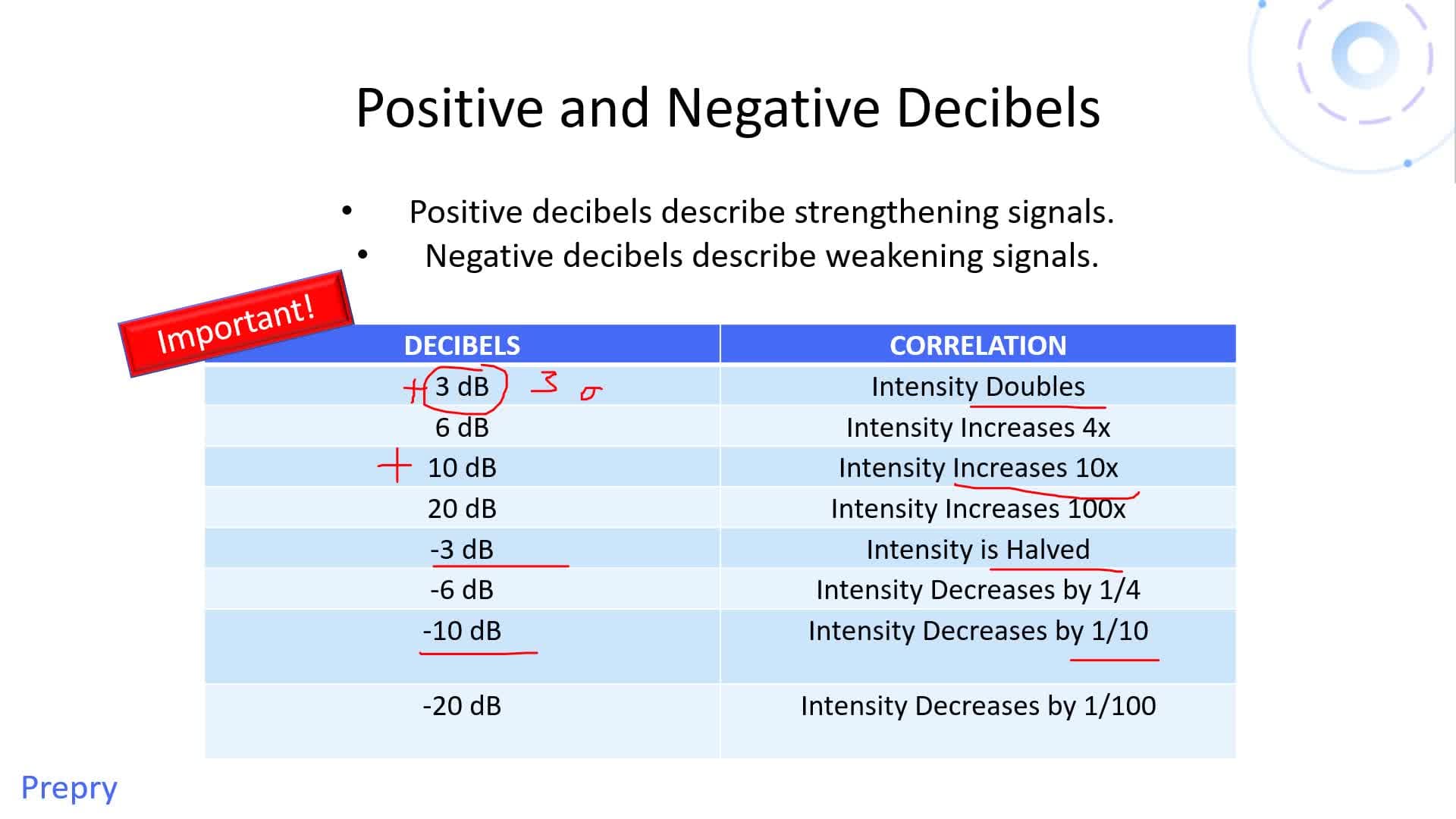
Attenuation is the progressive weakening of an ultrasound beam as it travels through tissue, from absorption, scattering, and reflection. In soft tissue the attenuation coefficient in dB/cm equals half the frequency in MHz, and total attenuation in decibels equals that coefficient multiplied by the path length in cm. Because the coefficient rises with frequency, higher-frequency transducers and deeper structures both lose more signal, which is why raising frequency trades penetration for resolution.
On the exam: SPI questions give a frequency and depth and ask you to solve for the attenuation coefficient or the total attenuation in decibels.
Frequency
Frequency is the number of complete sound wave cycles per second, measured in Hertz, and diagnostic ultrasound uses roughly 2 to 18 MHz. It is set by the transducer and stays constant as sound crosses into a new medium, unlike wavelength, which changes with propagation speed. Higher frequency shortens wavelength and improves resolution, but it also raises scattering and attenuation, which is why higher frequencies penetrate less deeply.
On the exam: SPI questions give a transmitted, fundamental frequency and ask for the second harmonic, which is always double it.
Transcript
19:41 lessonAttenuation is the decrease in sound intensity as the acoustic beam propagates through a medium. Factors like absorption, reflection, and scattering influence this process, with higher frequencies attenuating more rapidly.
Ready to Test Your Knowledge?
Practice with hundreds of questions designed to help you pass the SPI Exam.
Get Full Access
Unlock all SPI Exam Prep video lessons plus practice questions.
- All video lessons in this course
- 10,000+ practice questions
- Pass guarantee included
25 free questions per exam plus the Question of the Day. No credit card required.