
Parts of the Sound BeamNear Field & Focal Zone (ARDMS SPI)
Parts of the Sound Beam
Explore the anatomy of the ultrasound beam, including the near field, focal zone, and far field regions. Understand how transducer diameter and frequency influence focal depth and the role of Huygens' wavelets in beam formation. ARDMS, ARRT, and CCI registry exam preparation.
Lesson Overview & Exam Focus
Explore the anatomy of the ultrasound beam, including the near field, focal zone, and far field regions. Understand how transducer diameter and frequency influence focal depth and the role of Huygens' wavelets in beam formation. ARDMS, ARRT, and CCI registry exam preparation.
Key Exam Takeaways & Study Notes
- Explore the anatomy of the ultrasound beam, including the near field, focal zone, and far field regions.
- Understand how transducer diameter and frequency influence focal depth and the role of Huygens' wavelets in beam formation.
- The sound beam narrows from the transducer footprint to the focus due to constructive interference of Huygens' wavelets.
- High-yield ARDMS SPI registry concepts in Parts of the Sound Beam: sound beam, near field, focal zone, Fresnel zone, Huygens' wavelets, focal depth.
Parts of the Sound Beam: Registry Exam FAQ
What does Parts of the Sound Beam cover on the ARDMS SPI registry exam?
Explore the anatomy of the ultrasound beam, including the near field, focal zone, and far field regions. Understand how transducer diameter and frequency influence focal depth and the role of Huygens' wavelets in beam formation.
Which high-yield ARDMS SPI topics and keywords are tested in Parts of the Sound Beam?
Key registry concepts tested in this lesson include sound beam, near field, focal zone, Fresnel zone, Huygens' wavelets, focal depth. Knowing how these concepts appear on clinical images and physics questions helps you avoid common ARDMS SPI exam distractors.
Key Registry Concepts in This Lesson
Full Glossary →Frequency
Frequency is the number of complete sound wave cycles per second, measured in Hertz, and diagnostic ultrasound uses roughly 2 to 18 MHz. It is set by the transducer and stays constant as sound crosses into a new medium, unlike wavelength, which changes with propagation speed. Higher frequency shortens wavelength and improves resolution, but it also raises scattering and attenuation, which is why higher frequencies penetrate less deeply.
On the exam: SPI questions give a transmitted, fundamental frequency and ask for the second harmonic, which is always double it.
Focal zone
The focal zone is the region of the beam surrounding the focus where it is narrowest, giving the best lateral resolution available at that depth, with roughly half the zone in the distal near field and half in the proximal far field. Sonographers place it at or just below the structure of interest to sharpen lateral resolution there. Using a single focal zone rather than several also keeps frame rate, and therefore temporal resolution, higher.
On the exam: SPI questions test that lateral resolution is best within the focal zone, and that adding more focal zones improves image detail but lowers frame rate.
Near field
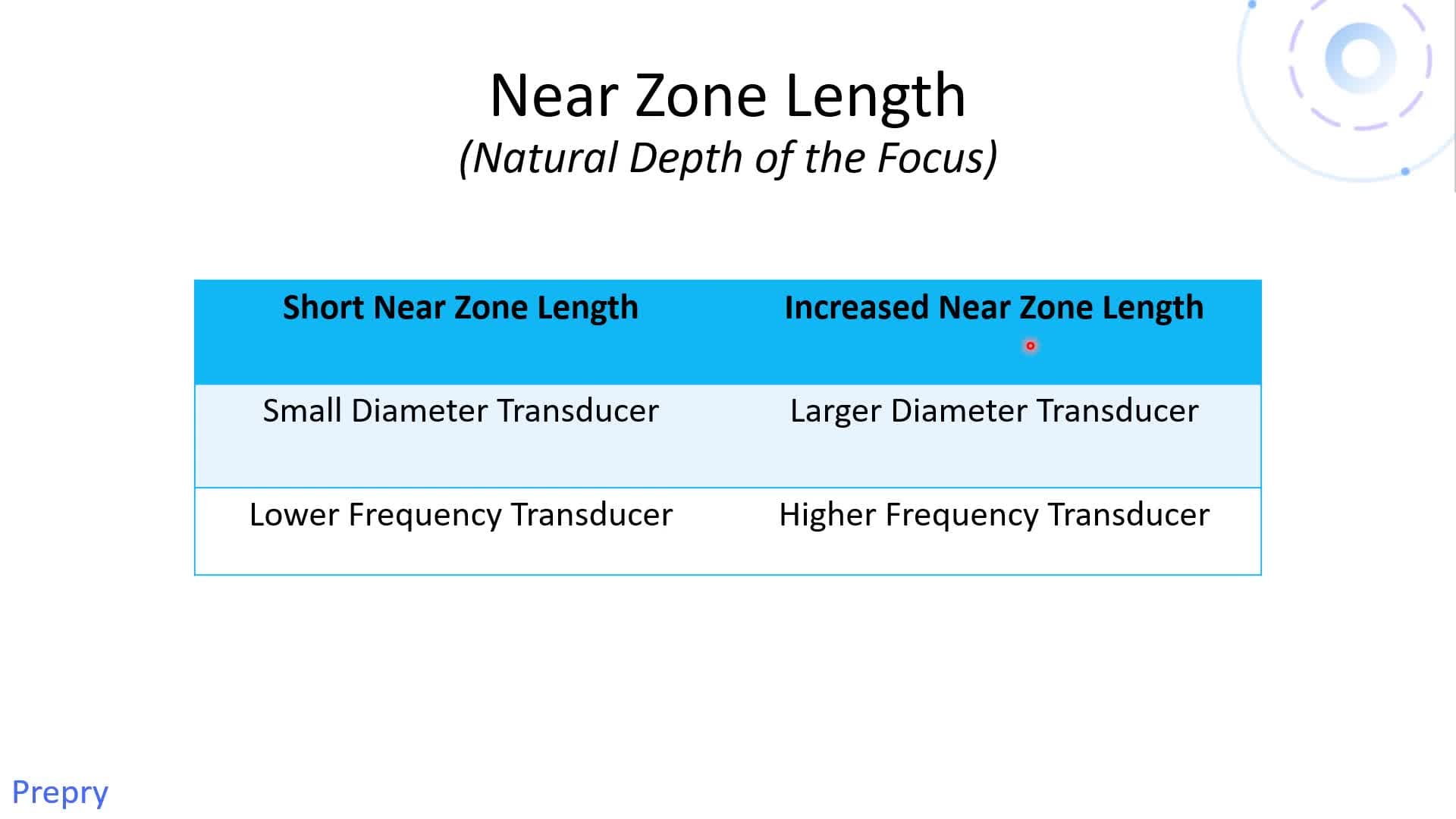
The near field, or Fresnel zone, is the part of the beam between the transducer face and the focus, where the beam converges and narrows. Its length grows with a larger transducer diameter or a higher frequency, which lets the focus sit deeper and can improve resolution further from the skin. Structures too shallow for a clear image can be pushed into the near field's useful range with an acoustic standoff pad.
On the exam: SPI questions ask how increasing transducer diameter or frequency lengthens the near zone and moves the focus deeper.
Far field
The far field, or Fraunhofer zone, is the part of the beam beyond the focus, where it diverges and spreads with increasing depth. A small, low-frequency transducer spreads the most; a large, high-frequency one spreads the least, and less spread means better lateral resolution out here. Because the beam is wider here than at the focus, lateral resolution steadily worsens the farther a structure lies past the focal zone.
On the exam: SPI questions test that a large-diameter, high-frequency transducer gives the least beam divergence, and therefore the best lateral resolution, in the far field.
Transcript
11:02 lessonThe sound beam narrows from the transducer footprint to the focus due to constructive interference of Huygens' wavelets. Near zone length is determined by transducer diameter and frequency.
Ready to Test Your Knowledge?
Practice with hundreds of questions designed to help you pass the SPI Exam.
Get Full Access
Unlock all SPI Exam Prep video lessons plus practice questions.
- All video lessons in this course
- 10,000+ practice questions
- Pass guarantee included
25 free questions per exam plus the Question of the Day. No credit card required.