
Transducer Components: Part 2Pulse Wave Transducer & Backing Material (ARDMS SPI)
Transducer Components: Part 2
Explore the differences between pulse wave and continuous wave transducers, focusing on backing material and its impact on axial resolution. Understand how PZT thickness determines frequency and the relationship between bandwidth and quality factor in broadband imaging. ARDMS, ARRT, and CCI registry exam preparation.
Lesson Overview & Exam Focus
Explore the differences between pulse wave and continuous wave transducers, focusing on backing material and its impact on axial resolution. Understand how PZT thickness determines frequency and the relationship between bandwidth and quality factor in broadband imaging. ARDMS, ARRT, and CCI registry exam preparation.
Key Exam Takeaways & Study Notes
- Explore the differences between pulse wave and continuous wave transducers, focusing on backing material and its impact on axial resolution.
- Understand how PZT thickness determines frequency and the relationship between bandwidth and quality factor in broadband imaging.
- Pulse wave transducers utilize backing material to shorten pulse duration, improving axial resolution.
- High-yield ARDMS SPI registry concepts in Transducer Components: Part 2: transducer components, pulse wave transducer, backing material, axial resolution, bandwidth, quality factor.
Transducer Components: Part 2: Registry Exam FAQ
What does Transducer Components: Part 2 cover on the ARDMS SPI registry exam?
Explore the differences between pulse wave and continuous wave transducers, focusing on backing material and its impact on axial resolution. Understand how PZT thickness determines frequency and the relationship between bandwidth and quality factor in broadband imaging.
Which high-yield ARDMS SPI topics and keywords are tested in Transducer Components: Part 2?
Key registry concepts tested in this lesson include transducer components, pulse wave transducer, backing material, axial resolution, bandwidth, quality factor. Knowing how these concepts appear on clinical images and physics questions helps you avoid common ARDMS SPI exam distractors.
Key Registry Concepts in This Lesson
Full Glossary →Axial resolution
Axial resolution is the ability to display two structures lying one behind the other, along the beam's path, as two separate echoes. It is determined entirely by spatial pulse length, since axial resolution equals spatial pulse length divided by two, so shorter pulses give better, smaller-number resolution. Raising frequency or damping the transducer more heavily shortens the pulse and improves it. The depth of the reflector itself has no effect on axial resolution.
On the exam: SPI questions test that axial resolution depends only on spatial pulse length, not on how deep the reflector lies.
Frequency
Frequency is the number of complete sound wave cycles per second, measured in Hertz, and diagnostic ultrasound uses roughly 2 to 18 MHz. It is set by the transducer and stays constant as sound crosses into a new medium, unlike wavelength, which changes with propagation speed. Higher frequency shortens wavelength and improves resolution, but it also raises scattering and attenuation, which is why higher frequencies penetrate less deeply.
On the exam: SPI questions give a transmitted, fundamental frequency and ask for the second harmonic, which is always double it.
Damping
Damping is the reduction of ringing in a piezoelectric element after it is excited, done with a backing material bonded to the back of the crystal that absorbs excess vibration. Heavier damping shortens the pulse and spatial pulse length, which improves axial resolution and widens bandwidth, at the cost of reduced sensitivity. A detached or failing backing layer is a recognized cause of an enlarged dead zone on quality assurance testing.
On the exam: SPI questions describe backing material shortening the pulse to improve axial resolution, and identify a failing damping layer as a cause of an enlarged dead zone.
Bandwidth
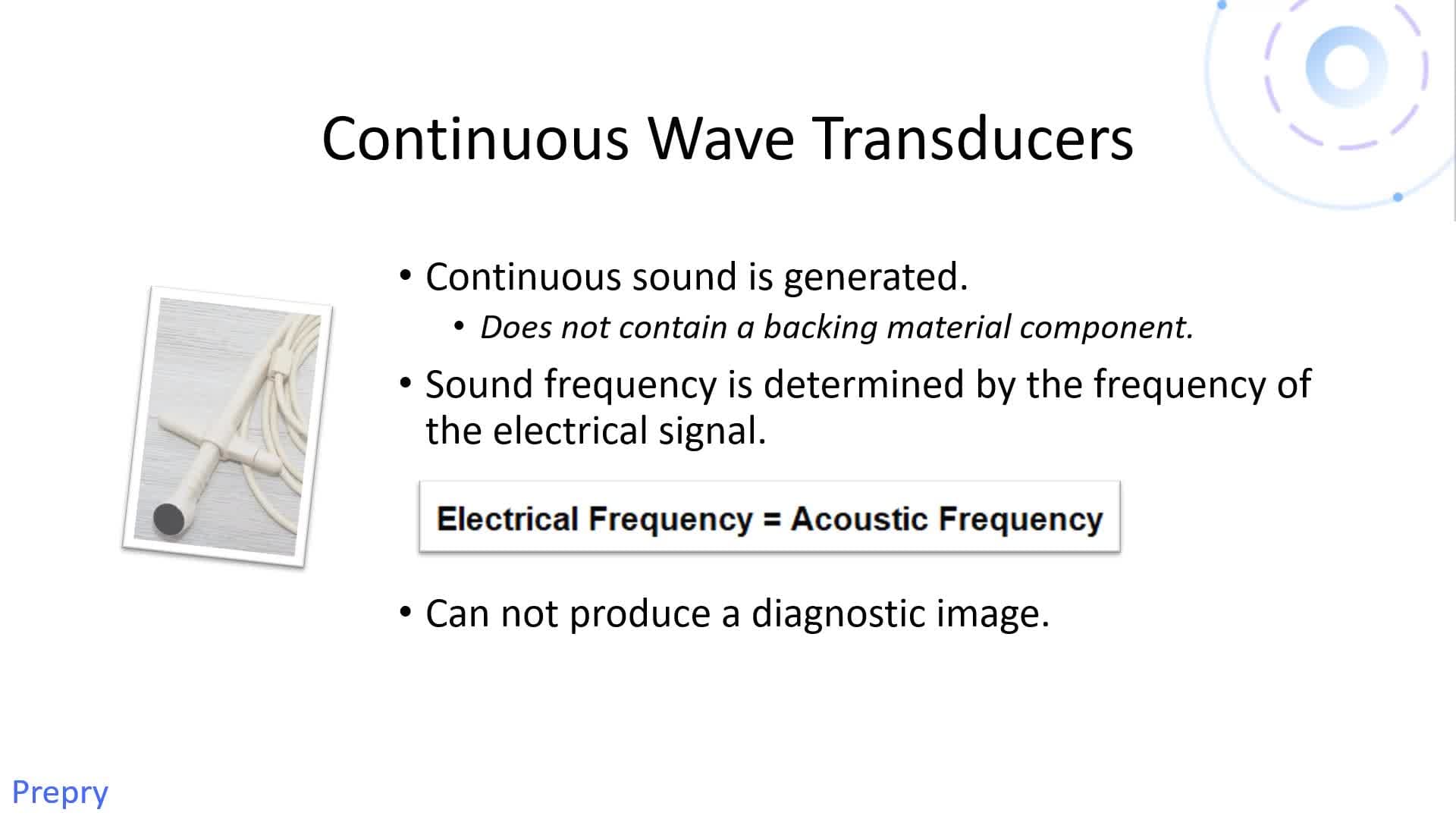
Bandwidth is the spread of frequencies a pulse carries instead of one pure tone, measured in Hertz as the difference between the pulse's highest and lowest frequency. Shorter, heavily damped pulses contain a wider range of frequencies and so have wider bandwidth, which goes along with a short spatial pulse length and good axial resolution. Continuous wave transducers, by contrast, have a narrow bandwidth and a high Q factor.
On the exam: SPI questions link wide bandwidth to short, heavily damped pulses used in imaging, and narrow bandwidth to the single-frequency pulse of continuous wave Doppler.
Transcript
16:12 lessonPulse wave transducers utilize backing material to shorten pulse duration, improving axial resolution. Bandwidth represents the range of frequencies, while quality factor describes frequency purity.
Ready to Test Your Knowledge?
Practice with hundreds of questions designed to help you pass the SPI Exam.
Get Full Access
Unlock all SPI Exam Prep video lessons plus practice questions.
- All video lessons in this course
- 10,000+ practice questions
- Pass guarantee included
25 free questions per exam plus the Question of the Day. No credit card required.